
Accurate Speedometer…Finally
Posted: July 18, 2025 Filed under: Uncategorized | Tags: speedometer, yellow box Leave a commentFor those regular readers, you’re familiar with my recent trail Jeep saga. Transmission went out (violently) and that took out the engine. But I’m back on the road, I mean trail.
Since I bought this Jeep in August of 2019, a 2006 TJ Rubicon, the speedometer has read high, about ten percent. I figured I’d try to get the speedometer to read a little closer. The Jeep had stupid low mileage, less than 21k, and I wanted to keep it low.
I can’t remember what I looked into back then, but I ended up ordering a “Yellow Box” out of Australia. I must have realized that the Rubicon model has an electronic pick up for the speed sensor not a gear driven sensor. So, no simple gear swap.
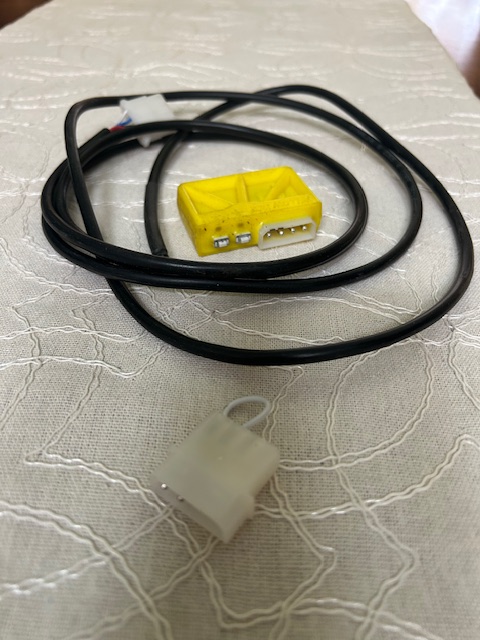
So, I ordered it up in 2019 and read the directions. It required cutting into the speedometer wiring and splicing in the unit. Rather than doing this under the Jeep at the speedometer sensor, where it was susceptible to water, dirt, mud, etc., I wanted to trace the wires back to the engine compartment and splice it in there. But the wire loom coming into the engine compartment has like 100 wires!
I put the Yellow Box on the shelf and figured I’d get back to it. I didn’t.
Six years later, I blew up the engine and trans. I figured this would be the time to get the speedometer reading correctly.
Because I’m running an Nth Degree lift kit, my rear suspension is actually a three link. Yes, a three link. At the front there is one connection to the frame. It’s right in the way of the speedometer sensor.


But I pulled the sensor, spliced in the Yellow Box and replaced everything. I soldered the wires. I tightly wrapped the connections individually with electrical tape, twice. I took the time to do it right.

It didn’t work. For those of you that don’t know, I have an electronics background. I can still read a basic schematic. I can solder wires. I was frustrated. I took it all apart and everything seemed correct. I double checked all the wiring and put it back together. It still didn’t work.
Rereading the directions and their website, again and again, I came across this…”We can only provide a small amount of tech support time per customer, so please check your installation carefully!” I reached out anyway.
My email was titled “Help…I messed up.” I confessed to ordering their Yellow Box years ago but I swear I wired it correctly, and it still doesn’t work. At the time, the 2-wire unit was the only one available.
Jennifer at Yellow Box could not have been a better customer support person. She sent out more technical documents, photographs, updated installation instructions, troubleshooting steps, etc. Many emails were exchanged.
Nothing worked.
She volunteered to send out a plug-and-play unit. I knew that I had wired it correctly, but I used it anyway. And at this point, I had cut and soldered the wires between the sensor and the plug so many times that I ordered a new speedometer sensor.
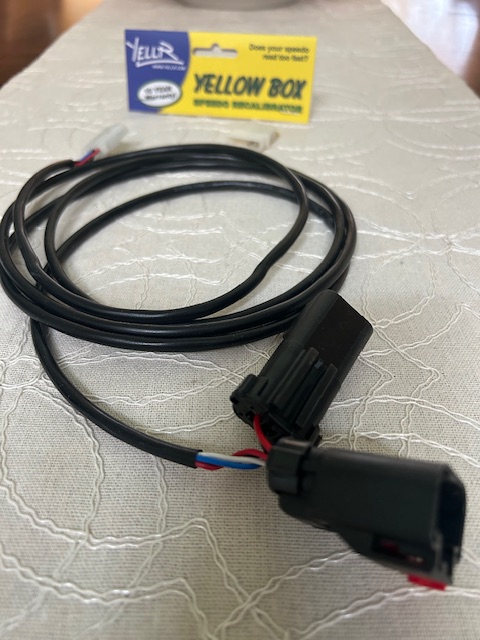
So, new sensor, new wiring…still didn’t work.
She ran me through one last set of testing, and with my electronics background I was able to send her the details of my step-by-step testing. Still nothing.
It turns out the older 2-wire Yellow Box will not work with my Rubicon model. So, I returned the older box, bought six years ago, and Yellow Box sent me a brand-new current model. This model is much easier to configure once installed.

Success!
The latest Yellow Box could not be simpler to install and configure with the plug-n-play wiring harness. The instructions have thousands of settings to dial in your speedometer to the exact ratio you need to get an accurate speedometer.
I fully recommend Yellow Box for calibrating your Rubicon speedometer, or any speedometer for that matter. The 2006 Rubicon is an odd duck with an older computer but newer electronic speedometer pick-up. I looked into aftermarket ‘power chips’ that allow you to adjust many things on the stock computer. They would not work. I went to my local speedometer shop and he couldn’t do anything. I went to my local speed shop to reconfigure the computer, nope. I even asked at the Jeep dealership. No luck.
Yellow Box worked.
Customer service in America has been on the decline for years. Nobody seems to want to do their job, especially in the service industry. Yellow Box has the best customer service I’ve ever experienced. Customer service in Australia lives on. Jennifer put in more time than she probably should have, and I very much appreciate that.
Thank you again, Jennifer!
For the record, Yellow Box has not asked me to do this. I was not compensated for this although I did get the ‘plug-n-play’ harness at no charge. This is an honest recommendation for an awesome product and company.
If your speedometer is off and you want it accurate, get in touch with Yellow Box…
.
Rubicon Ronin
.
For those 3-link non-believers…

Two regular arms off the axle. The diff skid plate actually has an arm that goes forward to the crossmember. There is a trackbar on the backside from the passenger side of the frame to the axle behind/above the diff. Nth Degree even installed new upper coil spring cups to relocate the top of the spring for the best possible angle for improved flex without binding.
Unfortunately, Nth Degree is no longer around. Replacement parts might be hard to find.
Side Trails and a Meeting with the LTBMU
Posted: July 2, 2025 Filed under: Uncategorized | Tags: gates, LTBMU Leave a commentGreat day today out on the Rubicon side trails.
I started up the Middle Fork Trail (15N38), then down the Red Cabin Trail or upper Barker Meadow OHV Trail (16E79), then across 03-04 to 03-04-12 and up to Ellis. I stopped at Ellis Lake and had lunch on Ellis Peak.
Starting down 16E79 there was a few trees encroaching on the trail. I winched one out of the way and it caught another and two were pulled back.
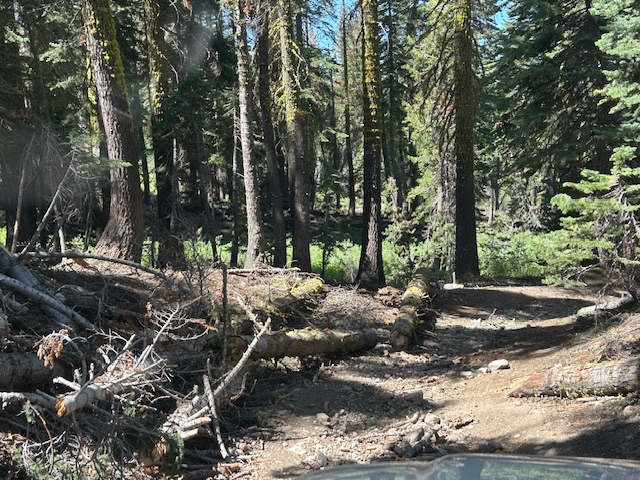
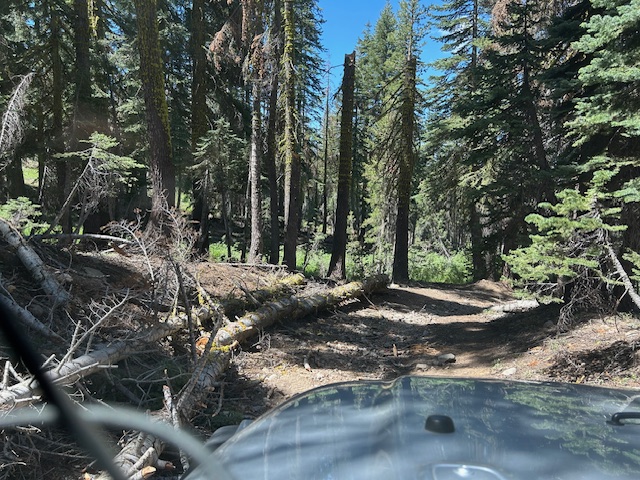
The TNF was able to cut a tree blocking 03-04 but they left it on the side of the trail. I took the time to pull it back and roll it off the trail.


The only snow I encountered was going into Ellis Lake. By the time you read this and then get out on the trail it will be gone.
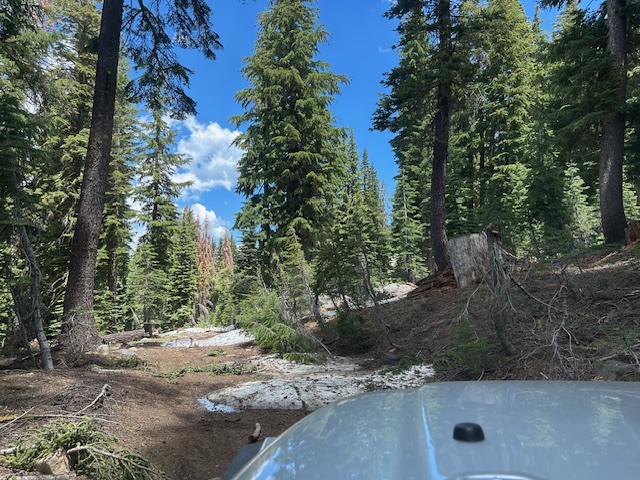
There were a few other little logs around and they were easily pulled off the trail.
I took the time to check out Ellis lake and Ellis Peak. If you’ve never climbed Ellis Peak it is a must. Ellis Peak proper is another 100 yards to the north, I didn’t bother. Do not drive the last section of trail. It is NOT an OHV trail. It’s loose, rocky and has NO turn around area at the top.
While at the top, I had lunch.
On the way home, I had a 2:30 meeting with the LTBMU about OHV gates and getting them open in a timely manner. The meeting went very well. No real promises made other than to work together to make our trails safe and to try to open the OHV gates on time.
Emails will be exchanged, maybe a meeting after Labor Day and a tour before winter. Hopefully, by Spring, we’ll have a plan to clear trails before their opening date so the trails can open on time.
.
Rubicon Ronin
Tahoe National Forest fire restrictions
Posted: July 1, 2025 Filed under: Uncategorized | Tags: fire, permit Leave a commentFire restrictions started yesterday on the Tahoe National Forest:
Release Date: June 24th, 2025
Contact Information: Lauren Faulkenberry 530-559-9010 lauren.faulkenberry@usda.gov
Tahoe National Forest plans to enter Stage 1 fire restrictions beginning June 30 due to increasing wildfire risk. Under these restrictions, campfires are still permitted in provided fire rings or charcoal grills within Tahoe National Forest’s developed campgrounds and day-use sites, but not outside of those areas. Smoking and operating internal combustion engines off roads or trails is also restricted except in limited circumstances outlined below.
“Due to increasing temperatures, dry vegetation and low humidity, it is critical that individuals planning to recreate on the forest take precautions when it comes to preventing wildfires,” said Tahoe National Forest Fire Management Officer Kyle Jacobson. “Last season, Tahoe National Forest experienced the highest number of wildfire starts out of all other national forests in Northern California. With public safety top of mind, fire restrictions is just one strategy we are implementing to help prevent wildfire ignitions on the forest.”
Tahoe National Forest typically implements fire restrictions over several stages, becoming more restrictive as each stage progresses. Increasing restrictions is informed by predicted weather, fuel moisture, fire activity levels and available fire suppression resources.
Under Stage 1 restrictions, the following activities are prohibited June 30 through Oct. 31, 2025:
- Building or maintaining a fire, campfire or charcoal briquette fire outside of provided fire rings or charcoal grills within designated developed campgrounds and picnic areas.
- Smoking, except within an enclosed vehicle or building, a designated campground or recreation area, or while stopped in an area at least three feet in diameter that is barren or cleared of all flammable material.
- Operating an internal combustion engine off paved, gravel or dirt National Forest System roads and trails, except within the Prosser Pits Developed Off-Highway Vehicle Area and boats on a water surface.
Under these restrictions, individuals with a valid campfire permit are still welcome to use portable cooking stoves, propane campfires or lanterns in an area at least three feet from any flammable materials. The portable device must only burn gas, kerosene, jellied petroleum or pressurized liquid fuel and have a shut-off valve. Campfire permits are available online at permit.preventwildfiresca.org or in-person at Tahoe National Forest Visitors Centers.
Help protect our forests, firefighters and communities by following these principles when out on forested lands:
- Campfires: Attend your campfire at all times. Ensure your fire is completely extinguished—drown with water (NOT dirt), stir with your shovel, drown again and feel for any heat using the back of your hand. Continue this process until no heat remains.
- Stoves: If using pressurized or bottled liquid fuel stoves, lanterns, or heating devices with a valid California Campfire Permit, use in barren areas with at least three feet of clearance from grasses and other debris that may catch fire. Prevent stoves from tipping.
- Vehicles: When traveling, ensure your chains are properly connected. The hot underside of the vehicle and dragging chains can start a fire. Stick to driving on designated roads and trails and be careful to not park your car or OHV in tall, dry, vegetation, including grass.
- Spark Arrestors: Ensure that all internal or external combustion engines have a spark arresting device properly installed, maintained and in effective working order.
- Smoking: Extinguish all smoking materials dead out on bare soil. Pack out all cigarette butts and filters.
- Fireworks: Fireworks are prohibited on all national forests year-round, leave them and all other pyrotechnic devices at home.

 The 'Other' Rubicon