Tahoe National Forest plans to enter Stage 1 fire restrictions beginning June 30 due to increasing wildfire risk. Under these restrictions, campfires are still permitted in provided fire rings or charcoal grills within Tahoe National Forest’s developed campgrounds and day-use sites, but not outside of those areas. Smoking and operating internal combustion engines off roads or trails is also restricted except in limited circumstances outlined below.
“Due to increasing temperatures, dry vegetation and low humidity, it is critical that individuals planning to recreate on the forest take precautions when it comes to preventing wildfires,” said Tahoe National Forest Fire Management Officer Kyle Jacobson. “Last season, Tahoe National Forest experienced the highest number of wildfire starts out of all other national forests in Northern California. With public safety top of mind, fire restrictions is just one strategy we are implementing to help prevent wildfire ignitions on the forest.”
Tahoe National Forest typically implements fire restrictions over several stages, becoming more restrictive as each stage progresses. Increasing restrictions is informed by predicted weather, fuel moisture, fire activity levels and available fire suppression resources.
Under Stage 1 restrictions, the following activities are prohibited June 30 through Oct. 31, 2025:
Building or maintaining a fire, campfire or charcoal briquette fire outside of provided fire rings or charcoal grills within designated developed campgrounds and picnic areas.
Smoking, except within an enclosed vehicle or building, a designated campground or recreation area, or while stopped in an area at least three feet in diameter that is barren or cleared of all flammable material.
Operating an internal combustion engine off paved, gravel or dirt National Forest System roads and trails, except within the Prosser Pits Developed Off-Highway Vehicle Area and boats on a water surface.
Under these restrictions, individuals with a valid campfire permit are still welcome to use portable cooking stoves, propane campfires or lanterns in an area at least three feet from any flammable materials. The portable device must only burn gas, kerosene, jellied petroleum or pressurized liquid fuel and have a shut-off valve. Campfire permits are available online at permit.preventwildfiresca.org or in-person at Tahoe National Forest Visitors Centers.
Help protect our forests, firefighters and communities by following these principles when out on forested lands:
Campfires: Attend your campfire at all times. Ensure your fire is completely extinguished—drown with water (NOT dirt), stir with your shovel, drown again and feel for any heat using the back of your hand. Continue this process until no heat remains.
Stoves: If using pressurized or bottled liquid fuel stoves, lanterns, or heating devices with a valid California Campfire Permit, use in barren areas with at least three feet of clearance from grasses and other debris that may catch fire. Prevent stoves from tipping.
Vehicles: When traveling, ensure your chains are properly connected. The hot underside of the vehicle and dragging chains can start a fire. Stick to driving on designated roads and trails and be careful to not park your car or OHV in tall, dry, vegetation, including grass.
Spark Arrestors: Ensure that all internal or external combustion engines have a spark arresting device properly installed, maintained and in effective working order.
Smoking: Extinguish all smoking materials dead out on bare soil. Pack out all cigarette butts and filters.
Fireworks: Fireworks are prohibited on all national forests year-round, leave them and all other pyrotechnic devices at home.
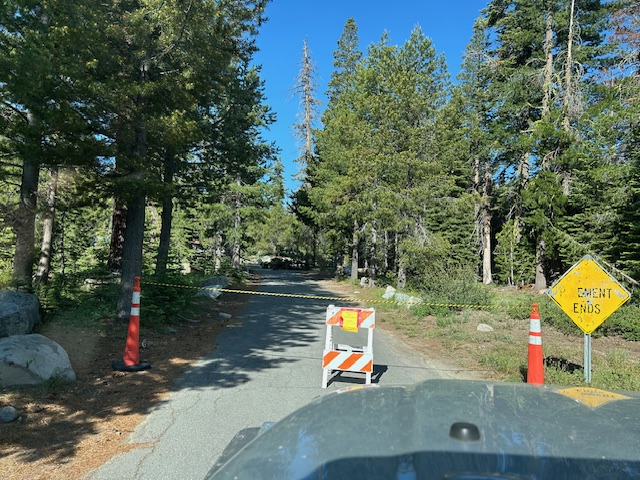
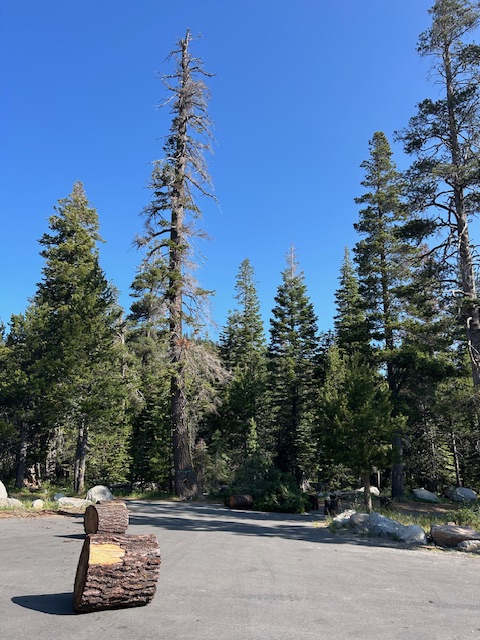
On my way in to clear trees this morning, I discovered the staging area had a HUGE area blocked off. Last week I posted about a guy calling me about a hazard tree. I thought that would have been taken care of by last weekend. Nope.
The main route is closed. You must go through the staging area.
It seems the Forest Service didn’t want to drop the tree while there were trucks and trailers in the parking lot. Now I didn’t drive out via Rubicon, I exited via Blackwood Canyon. I’m hoping the tree was taken care of today but I very much doubt it.
Now there is still green on that tree. So, I’m not sure what the hurry is all about.
So, if you’re headed up for Rubithon, parking might be tight. There is parking up Forest Road 03 or Blackwood Canyon, but you then need to run Forest Road 03-04 over to the Rubicon. Again, lower Hobbit is blocked by a down tree across the trail.
I have emailed the Forest Service to let them know this is unacceptable and I cc’ed the Rubicon Trail Foundation to help with more eyes on the issue. We’ll see who gets what done.
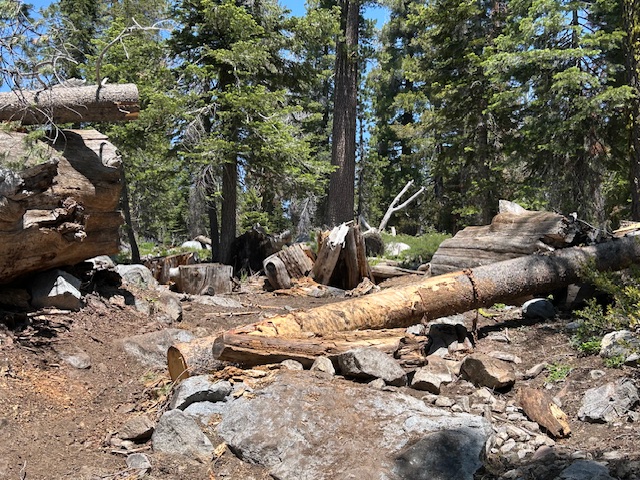
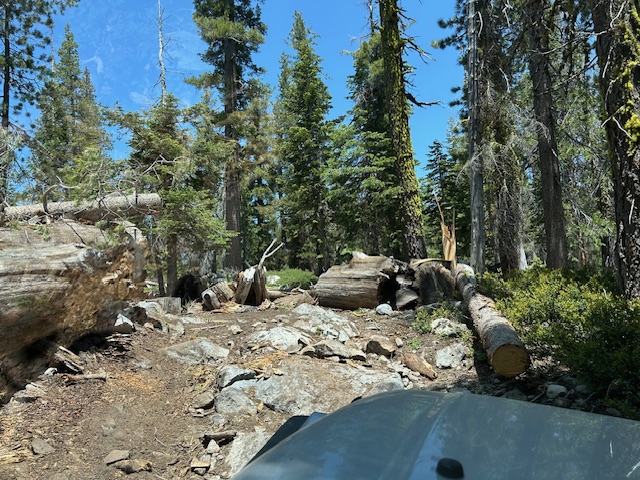
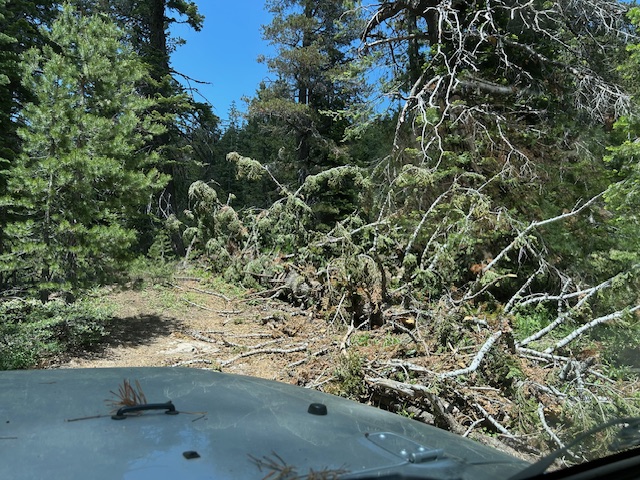
Hey everyone, I tried to clear the Hobbit Trails today, 16E76 & 16E79, but the last tree across 16E76 was too much for me. Also known as the Barker Meadow OHV Trail.
It started off quite productive. Obviously, someone had come through before me with a sizable chainsaw. The trail probably had snow at the time or they only cleared enough to get their rigs through.
A few before and afters…
I tried to clear it for all rigs. There were two spots where rigs had driven off trail to go around downed trees. The first one I cleared, the second on I could not clear alone.
These are pictures of maybe half the trees I moved:
It was fun trying to figure out where to cut and how to winch. This was just before the first creek crossing.
But, the trail is still blocked on the very east end, almost to Forest Road 03-04. I did not drive up 16E79, upper Hobbit, still Barker Meadow OHV Trail. Bring a saw and winching equipment if you go.
I have alerted the Tahoe National Forest about the trees I couldn’t deal with. Hopefully, they’ll get out this week to clear those trees.
I’ve received three emails and came across at least four websites claiming our public lands are being sold off to anyone, for any reason, anywhere. One post even claimed that the forest lands around or under the world-famous Rubicon Trail would be for sale. I don’t believe that.
For the record, I do not want to see federal lands with OHV trails sold off to the highest bidder. At the same time, as our cities grow, there is a need to expand. The sale of federal lands brings income. We can work to balance an agreeable outcome.
One of the emails I received was from the Nevada Offroad Association (www.NevadaOffroad.us). It has been copied and posted below. It paints a different picture. It has a Nevada twist and Nevada details but read it as applying to all federal properties/sales.
In this email, the actual pages of the document are cited for accuracy and for anyone to double check. I think, someone who goes to the trouble of citing page numbers in their argument can be trusted.
Please read the following email with an open mind.
As Yogi Berra once said Its “Déjà vu all over again”, but this time it is fear mongering about the public lands sales and exaggerating that all federally managed Public Lands is up for grabs.
To be clear – we at NVORA dislike the idea of selling public lands, but we also dislike the idea of the federal government “owning” our public lands, nor do we like the idea of every county needing to fund the management of every single acre within their bounds. But the elected leaders tell us they need more land for more housing. And the feds have most of the land.
Keep in mind – We are not here to discuss if Nevada needs more or less housing, that is outside of our skillset, yet every time we drive through some neighborhoods in the larger communities, that have abandoned or undeveloped lots, and the local government has not taken steps to utilize that land- it sure seems a bit rushed to ask for more land for more housing, ‘fix what you got’ then call on the people to sell our Public Lands- Nothing is ever – EVER- black and white.
So last month we (America) had a Public Lands sale included in HR1, that was removed, and now we have another one being inserted by the Senator from Utah. They are more similar than they are different. The primary difference is under the 1st attempt the lands sales in Nevada were limited to those lands identified for disposal in the proposed lands bills by senator Rosen and Masto early this year, and yet they were against selling the very same lands they asked to be sold. (scratches head) for the impacted areas, primarily Washoe and Clark County, (also Pershing county on a much smaller scale)
Disposal, for those of you who don’t read your kids bedtime stories gleaned from the tales within the Federal Land Policy and Management Act of 1976, is government speak for land that would be useful to sell for one of several reasons, for this conversation we will see the reason of – a lack of land to build new houses-. Those identified disposal lands are not identified verbatim in this current amendment however there is a very specific criteria on what qualifies, and in summary it is the urban interface, think of it as growing your community outward by a few miles or so.
The amount of land the agencies can identify for disposal is limited to 0.5% to 0.75% yes one half of a percent to three quarters of a percent of the land under public management. For clarity, the BLM manages +-48,000,000 acres in Nevada. using the larger value. Let’s do the math. 48,000,000 x 0.75% =360,000
And by now everyone has seen the map created by the Wilderness Society, they even include a table that breaks it down by state This is where they did the math and computed BLM to be “selling’ 30,053,344 acres in Nevada That is 75% not 0.75% of the public land.
One of two things has happened, a) They are crappy at math. or b) They think you are crappy at math.
Either way they were ‘off by a mile’ (or to be accurate 74437.5 square miles) an area larger than Nebraska.
But the problem isn’t mathematical ineptitude, it is that the news organizations & social media users jumped on and failed to check the data and are taking these numbers as gospel. Where their claim is even more problematic, is under that 0.75% – 360k acres is available…
BUT not all of it qualifies, as there is specific criteria on how the tracts are selected- in short the land must almost always be adjacent to existing communities. Nobody is buying public land on US-50 between Middlegate and Austin to build an apartment complex, or in the middle of the Amargosa Valley to build tract homes.
So ask yourself – Is the Wilderness Society lying to you just to get your emotions up? If they are, this is professional grade trolling for sure. Or do you think it is a simple mix up?
You can decide for yourself.
Our experiences with some of the more conservative ecologically focused groups certainly puts the thumb on the scale that helped us form our opinion. So you may ask why would any conservation group really get so worked up when the lands being removed from public inventory that borders are at the urban interface. Is this really a concern?
We think it is something to watch, as removing that access does push recreation a bit further into the desert, and along with the illegal dumping or encroaching on areas that are sensitive but not protected. So sure, we should all be interested along with these groups. But that is not what is happening, like we noted last time when the land sales were part of HR1, those were clean sales. The instruction was clear, – BLM FS sell the tracts ASAP. End of process.
What was missing then and what is missing now is the inclusion of more conservation areas or new protected areas. Areas that if you are a mountain biker, an OHV rider or 4X4 owner can simply be made off limits. It is the special interest land grabs that are missing from this bill.
That friends, is why the conservation community is up in arms, they are not getting enough special treatment.
In our opinion, it has ABSOLUTELY nothing to do with land sales, we think they are just writing it to pull at your emotional strings to try and get Americans that have more of the conservative ‘founding principles’ mindset on their side.
Professional grade trolling.
So below we have our notes from the bill, and we have included the reference so you can check our work – where you see [34-18] that tells the reader that on page 34 of the bill on line 18, you can see the exact wording as it is presented.
Topic by page numbers Page 1 – 22, Oil and gas leasing (Not land sale) Page 23-29 Mining (Not land sale) Page 30 – 41 Lands <– Land Sale 42-67 Fiscal instructions for contracting and payments received. (Not land sale) 68-69 Water infrastructure improvements/operations (Not land sale) Section 0301. MANDATORY DISPOSAL OF BUREAU OF LAND MANAGEMENT LAND AND NATIONAL FOREST SYSTEM LAND FOR HOUSING. [30-2] FEDERALLY PROTECTED LAND is NOT eligible for disposal this includes: [31-4] (A) a National Monument; (B) a National Recreation Area; (C) a component of the National Wilderness Preservation System; (D) a component of the National Wild and Scenic Rivers System; (E) a component of the National Trails System; (F) a National Conservation Area; (G) a unit of the National Wildlife Refuge System; (H) a unit of the National Fish Hatchery System; (I) a unit of the National Park System; (J) a National Preserve; (K) a National Seashore or National Lake shore; (L) a National Historic Site; (M) a National Memorial; (N) a National Battlefield, National Battlefield Park, National Battlefield Site, or National Military Park; or (O) a National Historical Park.
All preexisting rights to the land including Mining claims, grazing rights, rights of way or other leases are recognized [32-92] & [38-17]
Disposal is limited to 0.50 to 0.75 % of public lands each administered by the BLM and the USFS. [33-18]
Selection process: [34-5] The Agencies will select the tracts to be identified for disposal, and other interested parties may make nominations for those tracks as well. The state and local governments are also included in this nomination process. Before selecting any tract to be included as eligible for disposal the Federal component must consult with the Governor, the local impacted government (county city town) and the tribal nations if impacted. [35-7]
The nominations from the interested parties must include information for “the planned use of the tract” and “the extent to which the development of the tract of Bureau of Land Management land or National Forest System land would address local housing needs including housing supply and affordability. [35-19]
Priority consideration will be given to tracts that are nominated by the State or local Governments, are adjacent to existing developed areas, have access to existing infrastructure, are suitable for residential housing, reduce checkerboard land patterns or are isolated tracks that are difficult to manage. [36-11]
In addition to any tracts identified by the agencies the right of first refusal to purchase the lands at fair market value will be offered to the state and the local government. [37-4]
Limitations [37-10] Tracts shall be used solely for the development of housing or to address associated community needs.
5% of the land sale proceeds will go to the local government, (5% Seems a bit low) [39-10]
5% of the sales proceeds will go the deferred backlog of maintenance – so those roads that have not seen a blade, or the vault toilet that needs to be replaced, would receive some $ from this [40-15]
25% of the fees collected from renewables will go to the state, to be distributed to the counties [54-21]
And that payment to rural communities is *IN ADDITION* to the PILT funding they already get. Not a windfall but more than what they had yesterday [55-13]
Nevada Offroad Association · PO Box 1111 · Carson City, NV 89702-1111 · USA
So, my take is that although public lands will be sold, it is nowhere near the apocalyptic event being described on the internet. We should even have a say in what gets sold.
Sorry for the non-Tahoe-side-Rubicon rant, but I thought I should pass it along.








 The 'Other' Rubicon