
New RTF Trailer for the Tahoe side
Posted: February 22, 2014 Filed under: Maintenance | Tags: grant, RTF, Rubicon Leave a commentChristmas came late!
John Briggs, the Placer County liaison for FOTR, just received a brand new trailer for maintenance efforts on the Tahoe side. It belongs to RTF (Trailer RTF-06), obtained through OHMVR grant funding, and is on a “permanent loan” to the Tahoe side. If it is needed on the Eldorado side, we’ll bring it over.

I got a chance to check it out today. It was made by Varozza 4×4 Outfitters (www.Varozza4x4.com) out of Diamond Springs, CA, just south of Placerville. The basics: 2/3 of a yard capacity with a built in dump feature (air/hydraulic); 360 degree “Lock N Roll” rotating hitch (all you need is a 2” receiver); two piece swing out tailgate all on 35” BFG Mud Terrain tires. Another feature is the offset axle. It is offset up about 4” between the leaf springs in order to gain more clearance.
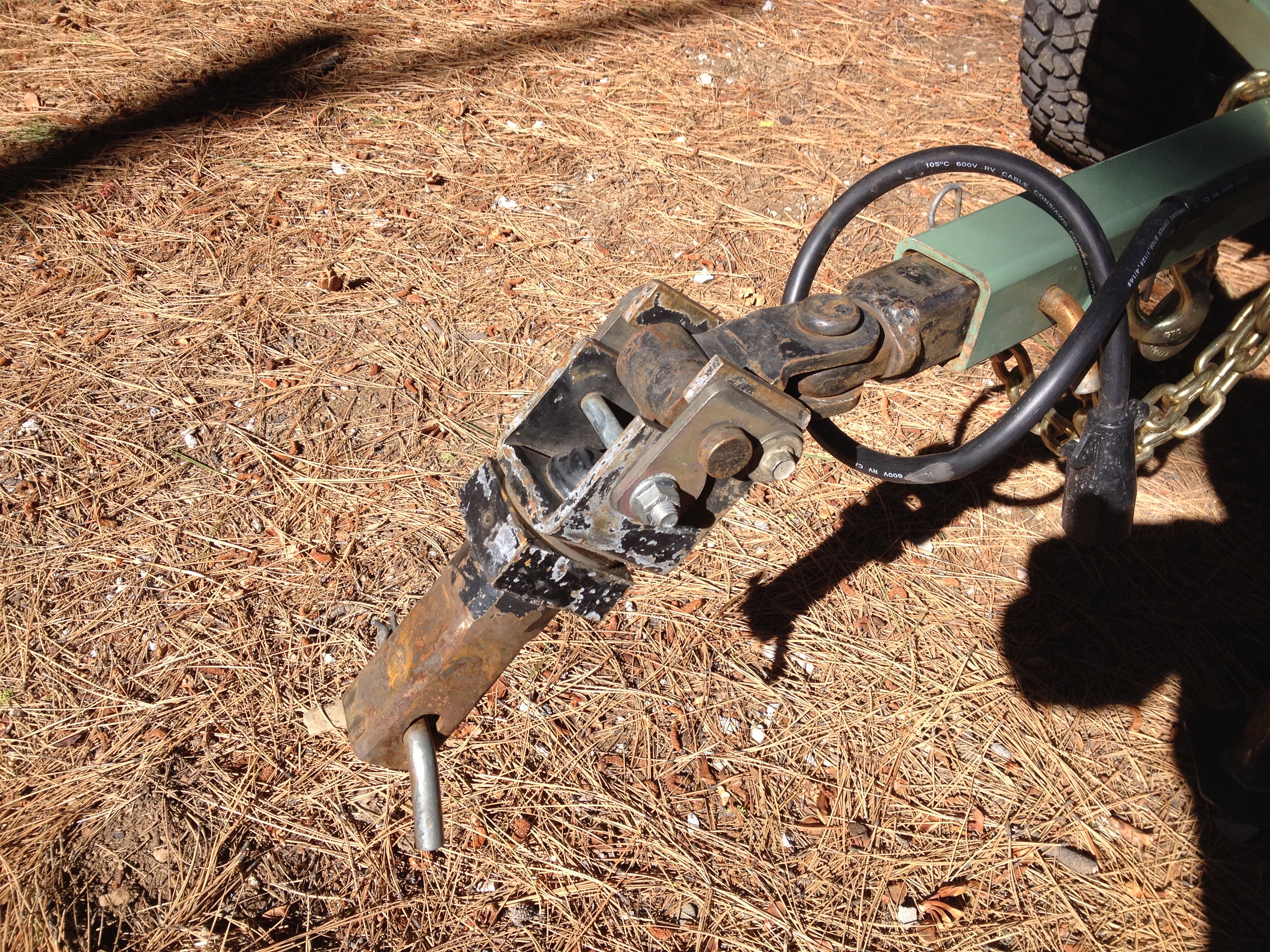
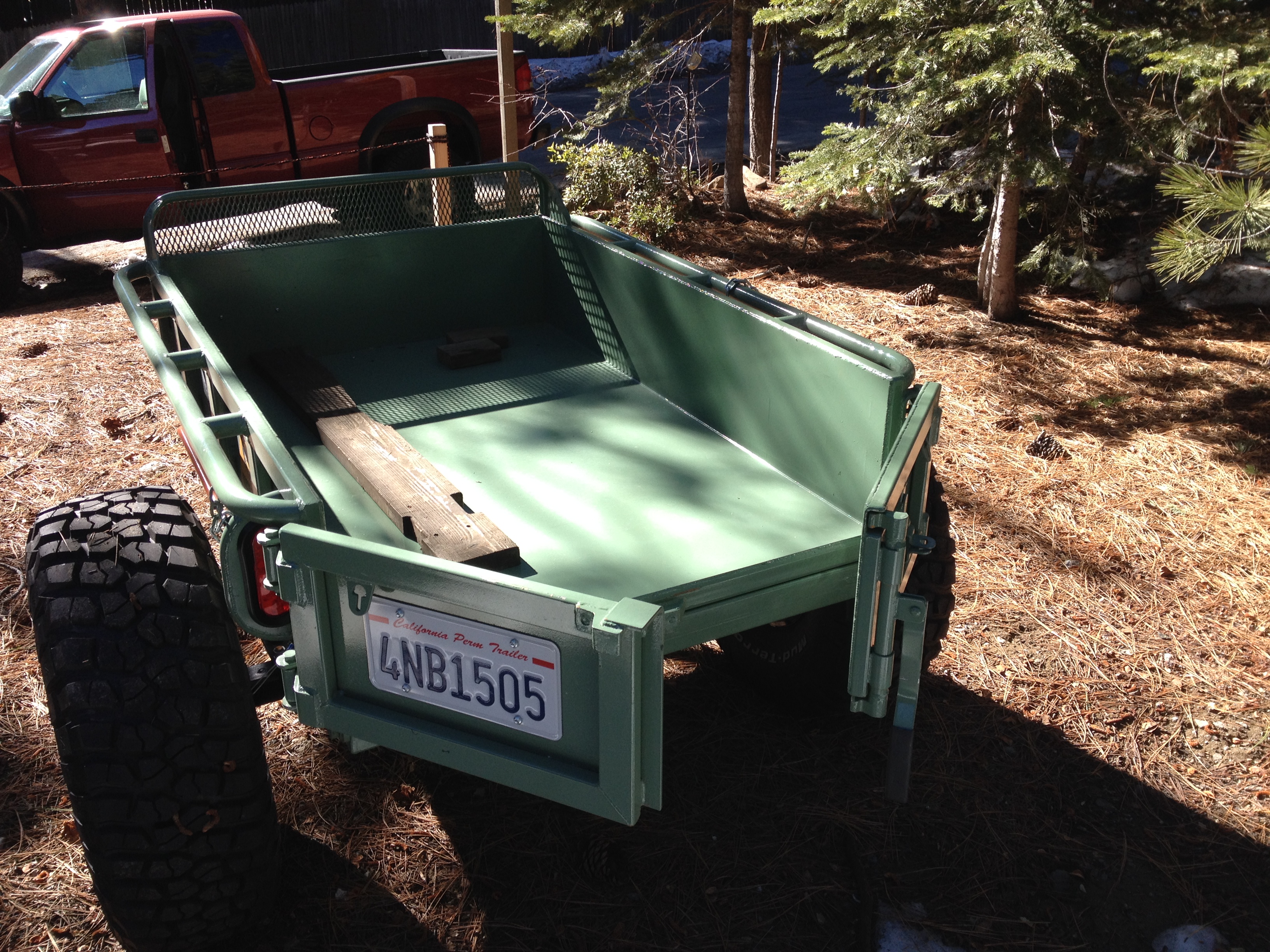

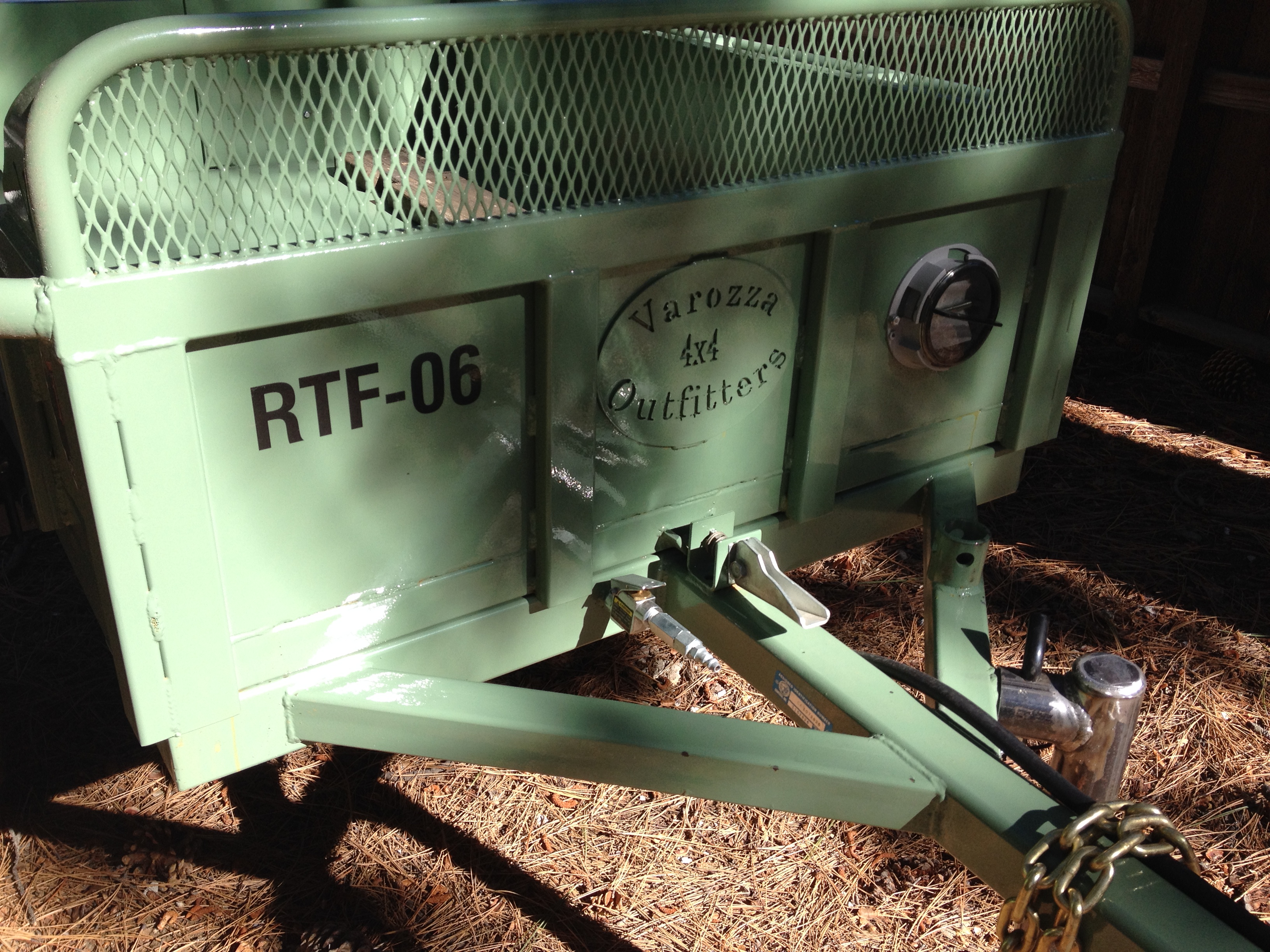
There is a standard air chuck intake like you would find on an air tool. There is a valve on the trailer to control the lifting of the trailer. Supply air and the bed tilts up, in order to lower the bed, you need to use the orange handle to turn the release on the hydraulic jack under the trailer. There is a latch to hold down the bed. In case you are out of air, there is a manual override by using the orange handle on the side of the trailer to pump the hydraulic jack under the trailer; quite awkward.
The trailer weight is low enough that it does not require fenders, nice! And the trailer paperwork is in a holder on the front of the trailer to prove that to any officer that tries to ticket you.
Specifications:
- Hitch height – 24″
- Bed dimensions – 60″ long, 40″ wide, 12″ deep (16 cu. ft./0.62 yards)
- Overall width – 70″
- Wheel pattern – Toyota 6 lug (I think)
- Weight – 1100 pounds (empty)
- Electric brakes – (needs 7 prong RV connector)
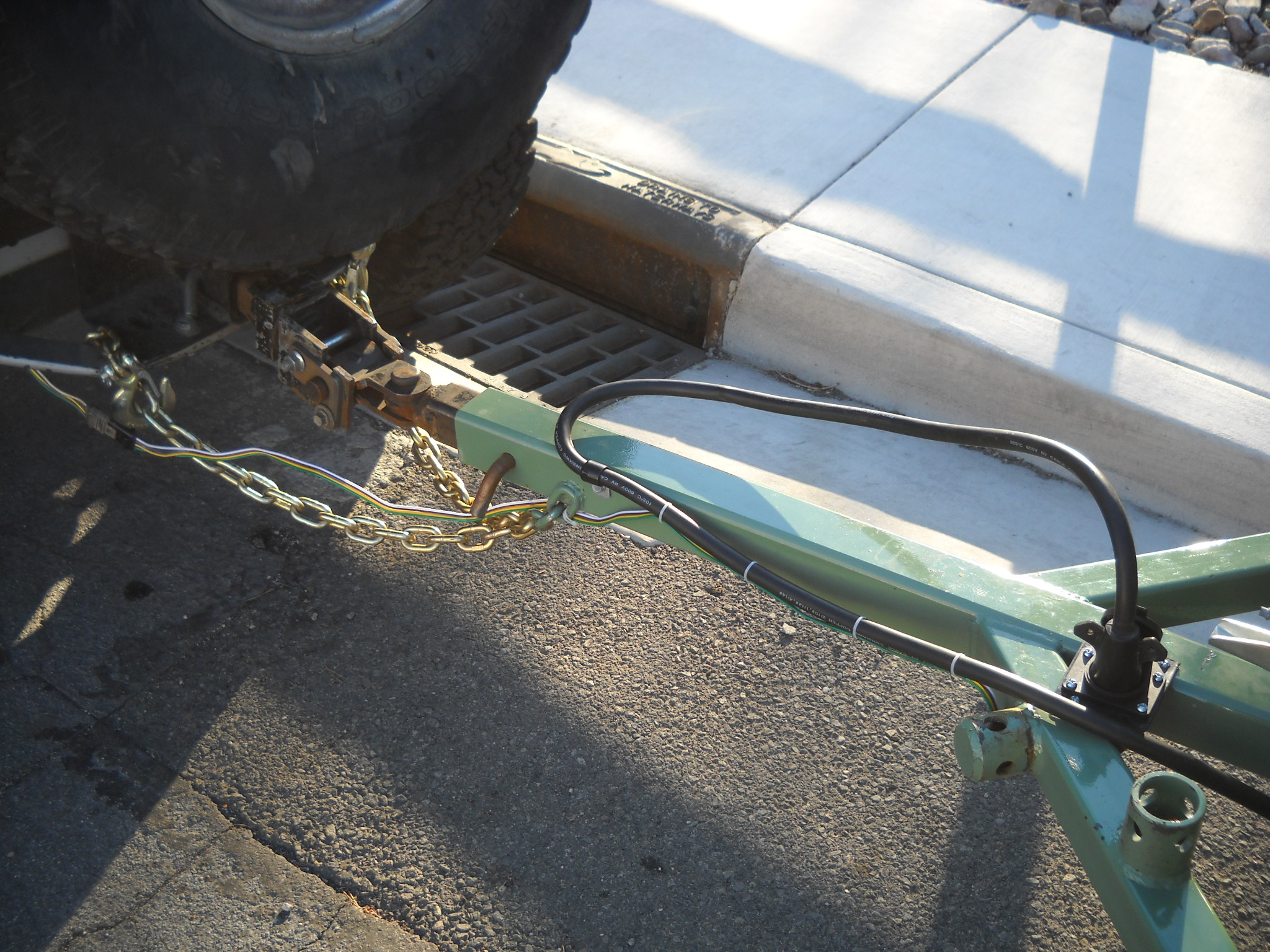
The trailer now has a mounted 7 to 4 adaptor. So, you can use the 7 prong connector (if you have one) to get the benefit of trailer brakes or plug the 7 prong in to the adaptor and use the flat four connector to get lights only.
Operation:
Before tilting the bed, open the dual tailgate doors and secure them with the small chains on the sides of the trailer. The trailer has a small square tube on each side to hold the chain to prevent it swinging and being noisy and chipping the paint.
To dump the trailer, you need to supply it with compressed air. Before opening the valve to supply air the trailer with air, unlatch the tilt bed from the trailer frame at the front of the trailer, if you don’t the bed won’t go up. (Trust me on this one.) The air to hydraulic pump surges, it sounds and feels like it’s giving the jack small bursts of air. Empty, the bed bounces and jerks a little bit. This operation uses quite a bit of air to operate.
There is a support brace under the trailer if you need to have the bed up for an extended period of time. Jack up the bed, reach under the bed and hold up the brace while you lower the bed on to the brace. This will provide a safer means of working on the trailer.
Speaking of working on the trailer, along with adding the electrical adaptor, I purchased and swapped out the air line from the valve to the pump. The original hose was not on all the way, so I reattached it. Then it blew, three times! I went and bought a steal braided reinforced 4000psi hydraulic line with threaded connectors on both ends. The hose will not leak or blow.
An example of how this will be used on the Tahoe side would be to finish the culvert removal project John Briggs headed up last summer. We still need to rock line the seasonal crossing to prevent any erosion and this will save some backaches, at least during unloading.
The trailer will be stored in a central location with a combination lock so arrangements can be made to let groups doing maintenance access it as needed. I’ve purchased a combination lock and John Briggs donated some chain. We’ll lock the trailer and provide the combination when someone needs it. The combination lock has a changeable combination so we’ll change the combination with each use.
This will be a huge help toward keeping the Rubicon Trail maintained and thus open for year ‘round motorized public use.
Thank you RTF for getting the grant and sending a trailer to the ‘Other’ Rubicon.
Adopt – a – trail (water bar)
Posted: January 19, 2014 Filed under: Maintenance | Tags: FOTR, grant, LTBMU, Placer, TNF Leave a commentThe Rubicon Trail Foundation has recently released information about the ability to ‘adopt’ a section of the Rubicon Trail within El Dorado County:

Okay, you’re asking, “I thought this website was about the Tahoe side of the Rubicon Trail?” Well, it is. Let me twist the story a little bit.
RTF has again stepped up to better organize getting maintenance done on the Rubicon Trail. They have worked out a plan with El Dorado County to have different clubs/groups/organizations to adopt a section of the world famous Rubicon Trail. Basic, routine maintenance and clean-up will be done by club members. Any major projects that come up will be led by the club but put out to FOTR for additional support as needed.
So, the Tahoe side twist is this, what about an “Adopt-a-water bar” program?
There were 28 ‘rolling dips’ (we all refer to them as water bars) built on the Rubicon Trail within the Lake Tahoe Basin Management Unit (LTBMU) in 2001. Over the years they have received some annual maintenance but they could use a little more love. This summer, Placer County will use OHMVR funds to create more rolling dips and drains (like 35 of them) along the Rubicon Trail between Miller Lake and the turn at Barker Pass Road (Forest Road 03).
Why not ask OHV clubs to ‘adopt’ one water feature, be it a water bar, a rolling dip or a drain? All that would be asked of these clubs would be to do maintenance on their one water feature once a year.
Dozens of clubs, from all over the western United States, organize an annual club run to the Rubicon Trail. It would be a simple addition to that trek to stop at the clubs’ one “Adopt-a-water bar” and spend an hour or so clearing the drain, digging out any sediment and re-covering any bare spots with rock.
As FOTR steps up to help Placer with labor and thus ‘matching finds’ for the OHMVR grant, the clubs involved could volunteer to adopt whatever water feature they were working on. This would establish ‘ownership’ from the beginning and instil pride in creating and maintaining each feature.
There would be some details to work out, namely, a Tahoe side local might be needed to scout the water feature to determine if any materials would be needed for any maintenance effort each year and then get those materials dropped off prior to the maintenance effort but easily overcome.
LEOs on the Rubicon Trail
Posted: January 6, 2014 Filed under: Access | Tags: grant, law enforcement, LTBMU, Placer, Rubicon, TNF Leave a commentLast May, I organized a meeting of different law enforcement agencies that have jurisdiction over the Rubicon Trail: Placer County Sheriff’s Office, Tahoe National Forest, CA State Parks and Lake Tahoe Basin Management Unit.
What I wanted to avoid was the lack of communication and the inconsistency of enforcement that plagued the El Dorado side of the trail when law enforcement started patrolling there years ago. The goal of the meeting was to do a face to face meeting of the different agencies and officers who would be patrolling the trail. We weren’t trying to solve issues or plan out the 2013 season but just get everyone in the same room.
The Rubicon Trail runs within Placer County and the county recognizes the trail as a public right of way, therefore, the Placer County Sheriff’s Office has jurisdiction on the trail. The Sheriff has put in for and was awarded OHMVR grant money to buy a side-by-side capable of getting anywhere on the Rubicon. The Rubicon will not be the only place the sheriff will use the side-by-side. Any OHV trail within Placer County can be considered the jurisdiction of the Placer County Sheriff.
The Tahoe National Forest has also received OHMVR grant money. They share law enforcement officers with the Lake Tahoe Basin Management Unit. The TNF also has an awesome ‘OHV Recreation Specialist’ that is a pleasure to work with. She and the TNF understand that motorized recreation is a legitimate use of our public lands. She also has access to the TNF’s newly built up Jeep Rubicon to patrol OHV trails within the forest. The Jeep currently lives in the Auburn area but can be requested for use in the Truckee/Tahoe area when needed.
The CA State Parks LEOs have been on the Rubicon Trail for years, but only on the El Dorado side. For 2013, things changed. The park service decided that El Dorado sheriffs and the ENF could handle the west end of the trail (This was before the county removed the ability of the FS to cite for county laws.) and so they moved their operation to the Tahoe side. The plan is to store a side-by-side at the nearby Sugar Pine State park and trailer it to the trailhead to use. They also have an officer who drives the state’s Jeep Rubicon, that is quite capable, and he loves to get it out on the trail. They are working to store equipment at Rubicon Springs so they can patrol on the way in, spend a night or two and then patrol on the way out. Again, the state parks LEO can patrol any OHV trail, so they are not limited to the Rubicon.
The meeting went well and all who attended were glad for the opportunity to put faces to the names of those officers in their sister agencies.
For 2014, I look forward to working with the different LEO agencies to maintain the safety of the OHV trails and public lands on the Tahoe side of the world famous Rubicon Trail.

 The 'Other' Rubicon