
Range Fence Repairs
Posted: June 23, 2014 Filed under: Access, Maintenance Leave a commentLast week, a buddy of mine and I did some quick repairs to the range fence on the Rubicon.
It had started to look pretty bad after a few winters of abuse:
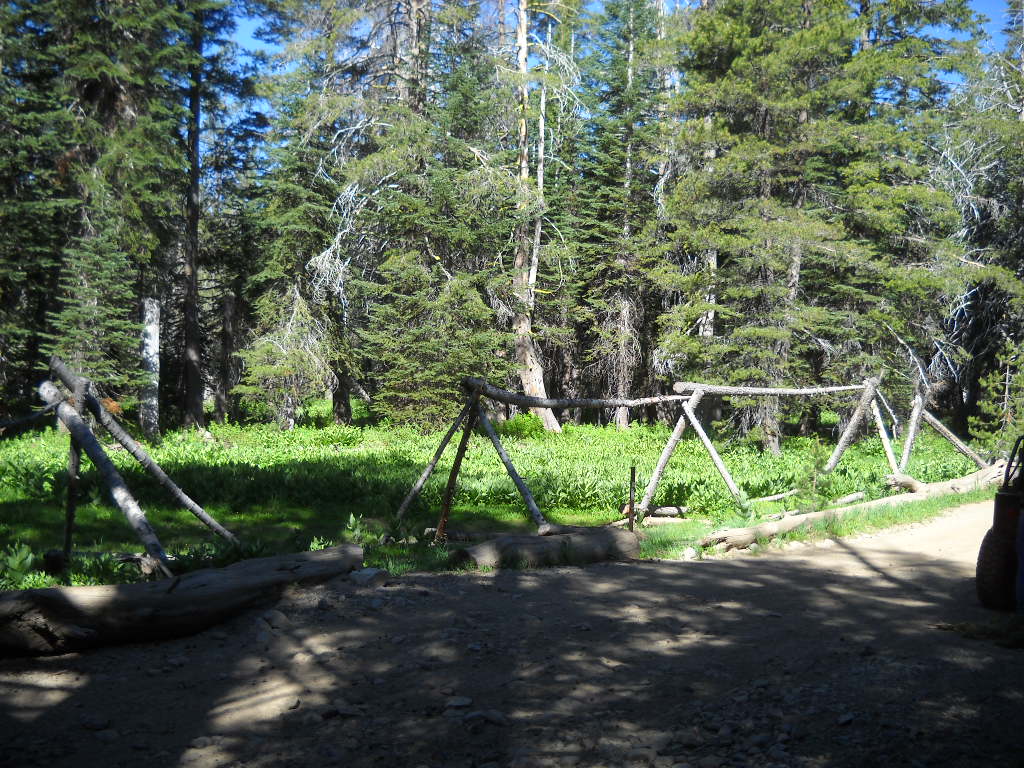
After scrounging a few trees blown over this last winter, we were able to unbolt the broken section and then drill and replace them with new ones.

If you’re not familiar with this project, a few rigs had driven off trail in this area to get around a large snow drift early one Spring. This range fence helps users recognize the edge of the trail in deep snow conditions while allowing snowmobilers to navigate around the area as needed.
Blocking a bypass (again)
Posted: June 16, 2014 Filed under: Access, Maintenance Leave a commentLast fall, I took the time to block two illegal single track bypasses along the Rubicon Trail. These bypasses were created by motorcycles and later enlarged by quads. They were “needed” because the Rubicon Trail had standing water on it. That should be read as tongue in cheek because these bypasses were not needed. All OHV users should stay on the trail. My line, that I should turn in to bumper stickers and t-shirts is “Turn around, don’t go around”.
Here are pictures from one of the two worked last fall. Before…

After…

I even took the time to wire tie most of the logs together to really let those who wanted to dismantle it know that they were going to have to work at it a if they wanted to break the law again.
Well, this spring, the logs were moved by those who didn’t have the skill to ride/drive through the water. I had put up signs asking that those who wanted to help maintain the Rubicon Trail for ALL types of users should contact FOTR. I never heard that anyone wanted to help do that work.
So, round two.
Only one of the two bypasses was blocked off this time around because only one water hole still had water. I’m hoping Placer County will come through with the grant and fix the trail so this is no longer an issue. But until then…
Before…
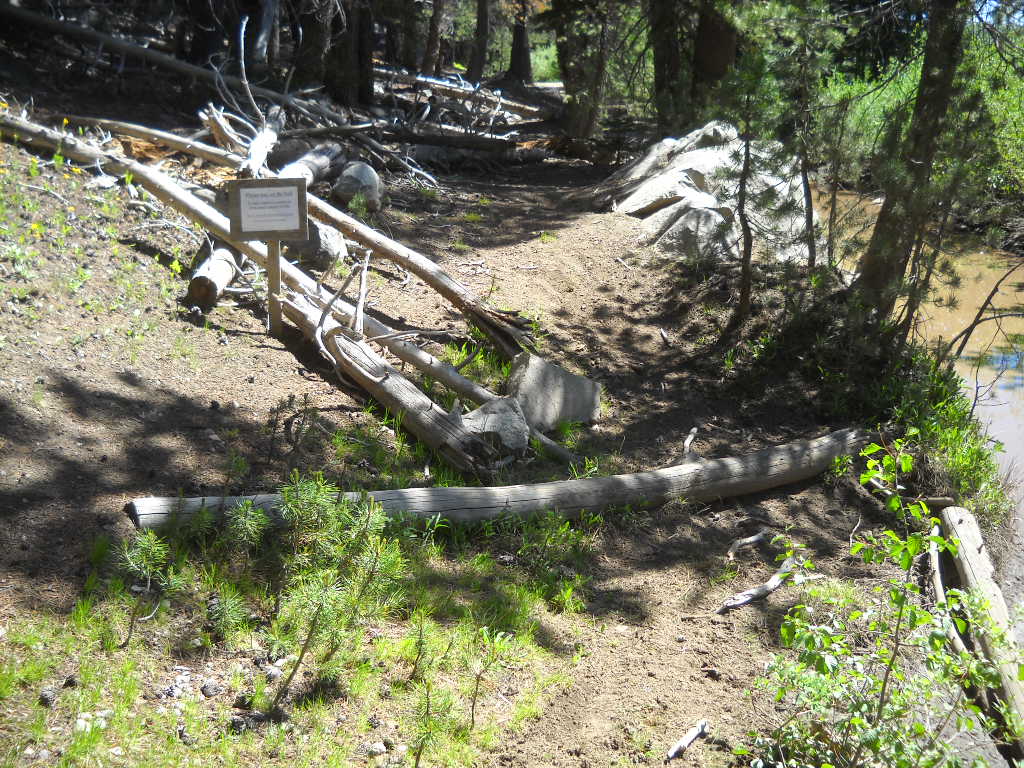


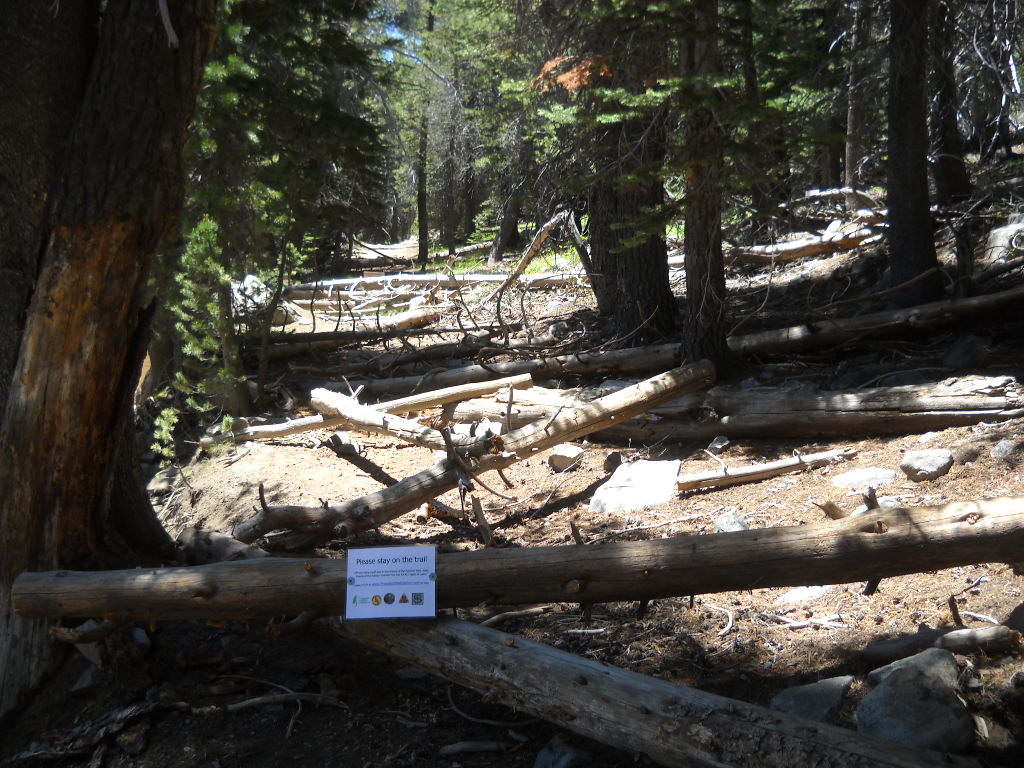
This time, some of the logs were drilled and anchored to the ground or each other with rebar.
Again, signs were placed stating to contact FOTR in order to help maintain the trail.
I’m all for ALL types of users on the Rubicon Trail and the surrounding trails but everyone needs to follow the rules. During discussions about users driving off trail, the idea of having Placer County close the trail if they can’t keep users on the trail was brought up. It was not seriously considered but it was discussed.
We need to educate each other about proper etiquette and the consequences of breaking the rules. Please take the time to politely educate anyone you witness breaking the rules.
Turn around, don’t go around.
Mother’s Day Wheeling
Posted: May 12, 2014 Filed under: Maintenance, Travel | Tags: Placer, Rubicon Leave a commentOn Sunday, after calling my mother and wishing her a happy Mother’s Day, a few of us headed up the Rubicon Trail.
Eric Agee, the new FOTR Placer side lead, wanted a quick tour of the Tahoe side. Two rigs and three people headed out of the staging area around 9:30am. Eric drove his Cruiser as I rode shotgun and talked about the trail. Paul followed in his CJ-7, just to have two rigs on the trip. Ham radios on a simplex frequency kept us in touch.
We stopped a lot along the way discussing different needs of the trail, which agency was responsible for what and what FOTR could do while Placer County did the proposed grant work.
The trail is still VERY wet and soft. I would encourage anyone thinking about driving it to put off your trip for a week or two. There were a few snow drifts along the way and we only went as far as the old mud hole that FOTR drained and filled in years ago, just west of the Potato Patch.
With the snow fall from the day before, there was running water where the seasonal creeks cross the Rubicon. This allowed us to get a good idea of what was working well and what would need a tune-up.
Yeah, that snow storm. I was up helping the Hi-Lo’s do some maintenance work on the Twin Peaks Trail in South Tahoe on Saturday. I decided to take the scenic route home up the west shore. Once I got to Tahoma, the snow started falling. By the time I got to Tahoe City it was a full blow snow storm. Unfortunately, my Jeep was only sporting a soft top with metal half doors and no uppers! And the back window was off. Needless to say I had a cold ride home. The snow finally stopped at stateline on 80 but it did turn to rain. I was having to wipe down the INSIDE of my windshield.
The ‘weekly photo’ is from inside my Jeep when I pulled in to the Shell gas station in Tahoe City.
On the way out, Paul heard a strange clunking sound coming from underneath his rig. We stopped and checked it out and the rear spring hanger on the right front leaf spring had been ripped off the frame. Eric suggested using the winch cable to wrap around the frame and actually through the spring hanger. It worked.
You never know what going to happen on the Rubicon.
Suggestions sent to FOTR…
Posted: April 26, 2014 Filed under: Maintenance | Tags: FOTR, Rubicon Leave a commentSo, FOTR is holding it’s annual meeting on Saturday, May 3rd in Placerville at the DOT office. I think it starts at 9am. Unfortunately, I won’t be able to attend. Bills to pay, so I have to go to work. I’d like to pass along some ideas that I hope will be discussed at the meeting.
FOTR Meetings
Let’s start right there, meetings. With only one meeting a year, odds are that some people will not be able to attend. With only one meeting, trying to follow up on action items or to plan out an entire year is difficult.
I’d like to suggest a non-symmetrical quarterly system.
Projects and Weekends: Hold a winter meeting in January to plan what projects FOTR will tackle and what weekends will be chosen for the work parties. Before the next meeting, an outline of each project should be drafted.
Leadership: The spring meeting would be held in March and would be for the details: we have the projects, we have the dates, we have an outline for each project. Who wants to lead a project, who wants to cook, who wants to do logistics, who wants to do whatever? Maybe discuss how each project needs to be tackled. The lead roles should be filled prior to the next meeting.
Worker Bees: The summer meeting in May would be presenting the completed RICS forms (or equivalent) with the IC’s, crew leaders and major logistics already in place. At this meeting we’d be looking for shovelers, check in people, trailers, etc. We’d be finalizing timelines, camping locations and what’s for dinner.
Review: The fall meeting held in September would be a review of what has been done and possible what’s left before the snow flies. The list of things to do would need to be reviewed/updated prior to the January meeting.
By splitting the one annual meeting in to four meetings, more details can be documented for each phase. More people, over the course of the year, will be able to attend and feel like they are part of the process thus increasing morale and buy-in from the users.
Membership Drive / Information Exchanges
So, how to get more people involved and informed…
My first suggestion is to post ‘Press Releases’ in as many OHV forums as possible.
The basic steps would be to slowly build an email list of people, and which forum they represent, who are willing to post any and all RTF/FOTR Press Releases on to a single forum. The individual posting the Press Release would NOT be responsible for answering any questions posted regarding the Press Release.
There would be a disclaimer on each Press Release stating that FOTR does not monitor this forum and although discussion is encouraged, any communication with FOTR should be done by emailing FOTR directly.
By sending one email, a single Press Release could easily be posted on a dozen forums. Eventually, that number could be dozens of forums. This effort would not only inform users but would also recruit volunteers.
A similar technique could be used to reach every Cal4 club in the state. Eventually other states could be included. Maybe monthly, a Press Release could be sent electronically to each club to be read at the clubs monthly meeting. This might take a little more effort to write as it would need to document what is going on with FOTR more than a month out. (Note: not every club currently has an email address on file with Cal4)
Possible wording for emails to representatives and on the Press Releases:
“You have received this email because you have volunteered to pass on information about the Rubicon Trail and Friends of the Rubicon. If you no longer wish to assist with maintaining the Rubicon Trail, please contact FOTR and you will be removed from this emailing list.”
“This forum is not being monitored by FOTR representatives, although discussion is encouraged and FOTR members might post up and answer questions and offer opinions, any comments or questions aimed directly at FOTR should be emailed directly to FOTR.”
A new position within FOTR could be created within FOTR, call it the ‘Public Relations’ person but limit the duties to dealing with emails, fliers and letters.
This person would work directly with the Trail Boss in creating Press Releases, maintaining the email lists for forums and for OHV clubs and for actually sending out the Press Releases.
The last thought in this category is to send out a questionnaire to all current FOTR volunteers, past volunteers and possible future volunteers in order to find out why volunteerism and leadership is down. Possible questions have already been forwarded to RTF. This should be sent out after an email list for forums and clubs has been developed.
Rebuild/Redirect the FOTR Leads list
This has been mentioned before but I don’t believe or never heard that it had been completed.
Currently, the Leads list falls flat when topics are brought up for discussion. If you’re going to be on the Leads list, you should make the time to get involved with the issues brought up on the email list.
I’d suggest asking each person to send a one page summary of why they want/should be on the Leads list. I don’t know how many people are currently on the Leads list but it shouldn’t be more than ten percent of the General list.
Once the new list is compiled and working, the Trail Boss should monitor who is failing to partake in the conversations. If you’re not taking part in the conversation, you get a warning; if you don’t step up and become part of the conversation; you’re off the list.
I’d like to see this change in order to drive more people to take part in discussing the current topics/issues facing the Rubicon Trail.
Organization Chart
There is an FOTR organizational chart and responsibilities for each position floating around from 2010. I believe it was a Bebe creation. Let’s fill it in.
Looking at the list, the only name I could fill in right now is that of Jerry Reffner as Trail Boss.
I currently hold the position of liaison with the TNF. John Briggs is the liaison with Placer County. Kade Hendricks is the current liaison with the LTBMU. Not major roles but they would fall in under Planning if the chart were expanded in detail. I know of no other roles current filled.
The suggestion above about clubs and forums could be driven by a Comms Chief. Below I suggest a Plans or Ops Chief to maintain a current “To Do List”. An RTF director should be the Finance Chief as RTF funds most of FOTR’s efforts.
I think in order to fill these positions we need to detail out the role and responsibilities of each and every position including the role of Trail Boss.
To Do List(s)
Create a single list of things to do for the entire trail. Then, prioritize or choose items from the list for 2014. GPS each issue. This summer, I will be getting GPS numbers for each item on the Tahoe Side to do list.
Currently, we have FOUR different “To Do Lists” floating around:
- Geographically east to west, by Doug
- A categorized but not prioritized list, by Rusty
- The Tahoe side priorities, by Tahoe side users
- Placer County’s priorities from ’13 FOTR meeting, by Kansas
This duty should fall to a Planning or Operations Chief. I do not favor a single person deciding what FOTR should work on. I’d like to see a committee working under Plans/Ops of six to eight people sit down and keep an eye on what issues face the trail and which are priorities.
This committee should maintain a list of 4-5 items that need to be done on the trail. This list should be posted on the FOTR website.
Miscellaneous:
- Develop an FOTR mission statement
- Define the objectives of FOTR
- Maintain the FOTR website with current information
- Reach out to motorcycle, quad and side-by-side users
- Education of volunteers: Offer training for leading a crew or a project; writing letters, emails, grants; filling RICS positions; basic organizational skills
Just thinking out loud…
Working with the Eldorado National Forest?
Posted: April 21, 2014 Filed under: Access, Maintenance | Tags: 14N39, ENF, Richardson Lake Leave a commentAs the only pro-OHV appellant from the east side of the Sierras, I have taken a personal interest in getting the Richardson Lake Trail, 14N39, reopened. One of my clubs, The North Tahoe Trail Dusters, often would organize a mid-week after work run to the top of Sourdough Peak for a BBQ and to watch the sunset. We’d then wheel down in the dark.
Trying to work ‘with’ the Eldorado National Forest (ENF) to get this trail reopened has been a challenge. My fallback line to them has been “Partnership Not Pushback” but it seems I get more pushback than partnership.
Early on, before the Record of Decision (ROD), I had organized a tour of 14N39. Scheduled to be there were all the right people from the ENF and the users to drive them. The day before the tour the head ENF ranger, Lawrence Crabtree, pulled the hydrologist to another project. We went anyway and documented the ‘meadow’ issues and how each could be fixed.
The ENF later changed the rules and claimed that no planning could be done on any fixes until the forest hydrologist could visit the trail and get eyes on the issue. They couldn’t read our notes and draft something; they couldn’t look at our photographs and draft something; they couldn’t work from the first hydrologist’s notes and draft something.
Read as a “How can we, the ENF, delay the reopening of this trail?”
But the hydrologist was not available later on to make it to the trail. Then the Lake Tahoe Basin Management Unit tried to help by sending their hydrologist to look at the trail. But an early snow flurry covered the trail the day before the scheduled tour. Let’s not discuss the fact that it didn’t snow again for months.
Read as a “How can we, the ENF, delay the reopening of this trail?”
So the winter went by with the ENF not willing to talk about possible fixes, not willing to talk about possible reroutes, not willing to talk about possible temporary fixes to the last meadow, not willing to talk about any possible maintenance, basically not willing to do anything that move this project forward. Pushback not partnership.
Read as a “How can we, the ENF, delay the reopening of this trail?”
Over the winter, I’m thinking about possible fixes to both the minor water issues and the last meadow reroute. I email a few questions to the ENF and don’t hear back. I finally email the boss of my ENF contact and I hear back from my contact. They snapped back about other things going on and being short staffed, etc. Pushback not partnership. They never did answered my questions.
Read as a “How can we, the ENF, delay the reopening of this trail?”
Spring arrives. I’ve already drafted a plan for the inevitable tour with the ENF and this time the hydrologist. Its three pages long: goals, objectives, list of possible attendees, communications plan, medical plan, timeline, etc. So, I contact the ENF to lay the groundwork for this tour that is still a month away due to snow.
I receive an email basically telling me that the ENF will send a group to tour the trail and then put out a plan of what the fixes will be. A second tour could be scheduled if needed for the appellants. Then there would be a comment period.
Read as a “How can we, the ENF, delay the reopening of this trail?”
There were so many ‘issues’ in this one email from the ENF that I contacted them and later drove over the hill to meet with them in person.
At the end of the meeting, I had still not got my way but had made a little ground. The ENF would still send out a team without users or appellants and would schedule a second tour with appellants, within a week, prior to drafting and publishing a plan. This would allow input from individuals outside the FS to comment prior to the ENF coming to a decision on how to fix any issues.
There are still many issues to ‘discuss’ with the ENF. The primary one being to start working on possible ways to temporarily ‘fix’ the last meadow issues to allow users to drive to the summit while the years long reroute gets completed.
Don’t worry, I’m still pushing. I’m aiming for a partnership but I’ll take anything as long as I can keep things moving forward.

 The 'Other' Rubicon