
LTBMU to hold OHV open house
Posted: March 25, 2015 Filed under: Access, Maintenance | Tags: education, Hi-Lo's, maintenance, OHV grant, Rubicon, Twin Peaks Leave a commentChange of the hours: it should have read 4pm to 7pm!
This is a great opportunity to let the Lake Tahoe Basin Management Unit know how we feel about how they are managing our OHV trails. They will be open for discussion on the proposed grant, the management of Twin Peaks, the Rubicon Trail and all other OHV related subjects.
Let’s get a big turn out and let the Basin know we care about our OHV trails and how we would like to see them managed.
Forest Service to hold open house on off-highway vehicle use
South Lake Tahoe, Calif. – The U.S. Forest Service Lake Tahoe Basin Management Unit (LTBMU) will host an open house to discuss Off-Highway Vehicle (OHV) use on designated routes within the Lake Tahoe Basin on Thursday, April 2, 2015, from 4 to 7 p.m. at the Forest Supervisor’s office at 35 College Drive, South Lake Tahoe, CA 96150.
The open house provides an opportunity for the public to meet Forest Service OHV, engineering, trails and recreation staff and ask questions regarding the LTBMU Motor Vehicle Use Map (MVUM) and the California Off-Highway Motor Vehicle Recreational (OHMVR) Grant application. Local OHV club members will be on hand to discuss membership and volunteer opportunities sponsored by the Forest Service.
Contact Adrian Escobedo at aescobedo@fs.fed.us for reasonable accommodation access to the facility or proceedings.
For more information, contact Tim Merten at 530-543-2863 or tmerten@fs.fed.us.
###
Grants are out for comments
Posted: March 3, 2015 Filed under: Maintenance | Tags: education, grant, LTBMU, maintenance, OHV State Parks, TNF Leave a commentGrants are out for comments
I’ll apologize up front, this is a long one. Grant funding is hugely important and honestly, I haven’t been active enough over the years. I’ve tried to hit the high points for you. Please take the time to comment on these and other OHV grants currently in the system. If we don’t comment, they won’t hear us.
Let’s start with Placer County.
In 2013, Placer got a nearly $300,000 grant from CA State Parks for the Rubicon Trail. It ran from Oct of 2013 to Oct of 2014. Placer County did not apply for a grant in 2014. I’ve already posted about how the work done under that grant fell short of many peoples and government agency expectations.
The community was hoping that Placer would learn from the 2013 grant and move forward with a follow up grant to finish the work done in 2014, specifically with greater oversight. That didn’t happen.
I’m hearing lots of rumors but nothing has been confirmed. So, I type this as speculation. I’m hearing that El Dorado County wrote and submitted Placer County’s grant proposal on behalf of Placer County. Good news, bad news. I’m good with that because the last I heard, Placer was not going to apply for ANY grant funding. The bad part is it is only a “Planning” grant with NO money for “Ground Operations”.
So, this Placer County grant funds three main points:
“Task 1 – Hydrological Inventory
This task will be performed by professionals with backgrounds in hydrology and geology. This task is of particular importance since, due to drought and climate change conditions, where the water bar and drainage crossings occur on the Rubicon Trail have likely changed and/or are in a dynamic state. The hydrologists will determine and inventory all crossings, including ones potentially impacted by drought conditions.”
“This task will consist of a full determination of all water crossings beginning where the Rubicon Trail begins at the exit of the McKinney residential neighborhood, to the El Dorado–Placer County Line after Cadillac Hill and before Rubicon Springs.”
“Task 2 – GIS Mapping
From the eastern neighborhood entrance, GPS point locations of the water crossings will be obtained and inventoried. This task is important as the locations will be subsequently used in a map to more accurately determine maintenance needs, potential water quality issues, as well as to direct Contractors or those unfamiliar with the Trail to locations along the Trail.”
“Placer County will also solicit input from user groups to include pertinent and some common Trail places of interest. It is important that all GPS point locations given will be relative to a consistent datum. These points will be field checked.”
“Task 3 – Hydrological Assessment
Using the information from Task 1 above, hydrologists and engineers will determine what and where would be the best location for the water to cross the Trail, as well as an assessment of the current functionality of the water crossing. This task will assess if water bars are properly cited, need to be upgraded or replaced, combined, under-sized, or are obsolete.”
“This task is ultimately a maintenance assessment that will be used in subsequent years to plan maintenance improvements for water quality and sediment erosion control. An additional future task would be to re-numerate the water crossings with markers. The re-marking would occur after the assessment, since it is probable that some of the current water bars can be eliminated. Marking and identifying the water crossings on the Trail, will be key in maintaining water quality in future years.”
The money plays out as follows: $89,000.00 in grant funding; $33,400.00 in matching funds by Placer County. That might include volunteer hours/work as matching funds; for a total grand grant of $122,400.00.
Although just a “Planning Grant”, this work will be a great step in repairing and maintaining the Rubicon Trail. I have heard, rumor only, that Placer County is willing to fund some ground work this summer, the summer of 2015.
All three of these points should be supported by OHV users, as I support them.
We’ll move on to the Tahoe National Forest (TNF).
The TNF grant is structured a little differently. The grant cycle for the TNF is January 1st to January 1st. The grant being applied for in 2015 will actually fund the OHV year of 2016.
This “Ground Operations” grant is designed and written to provide “funding to enable Tahoe National Forest (TNF) to meet annual baseline OHV operation, maintenance and monitoring needs from 1/1/2016 to 12/31/2016.”
It covers a vast list of projects and needs:
- Management of the OHV and OSV programs on all four districts.
- Contracts, equipment, salaries, services and supplies
- Monitoring: Soil, water quality, wildlife, plants, cultural sites
- The following activities will occur on or adjacent to the OHV routes (as needed):
- Repair/armor stream crossings
- Erosion and sediment control
- Removal of brush, loose rocks and down logs from the trail corridor
- Installment, repair and replacement of OHV barriers
- Tread maintenance to provide for safety, resource protection, etc
- Purchase, installation and replacement of signs
- Purchase and installation of gates
- Purchase and distribution of OHV trail maps
- Cleaning toilets and other staging area facilities (1-2 times/week)
- Hazard tree removal
- Toilet pumping
- Facility maintenance and repair
- Trash and litter removal
- Posting and maintenance of bulletin boards, signs and other visitor education services
- Water system testing and maintenance
- Purchase of two motorcycles for the Yuba River RD
- Purchase of minor equipment and supplies (hand tools, chainsaw supplies, beacons, safety riding gear, etc.)
If you read that list closely, you saw that it does contain the word “gate”. We don’t like gates. Unfortunately, gates are now part of an OHV reality. They are primarily used for closing seasonal trails, forest service access roads and roads to private property. Let’s stay on top of all forests and make sure that is the only use of gates.
The way I read the grant, the TNF has no major projects in mind with this grant just regular OHV trails maintenance, so, no bridges.
The money equation plays out as follows: $625,701.00 in grant funding; $220,509.00 in matching funds for a total of $846,210.00.
That’s quite a bit of money. But the TNF funds many OHV positions with OHV grant funds. Jeff Wiley in the Susanville office and Susanne Jensen in the Truckee office are just two examples. I wish the LTBMU would fund a dedicated OHV person for the Basin.
The TNF also has a grant for “Planning”. This grant covers:
- Identify existing public motorized access easement “gaps” in the Tahoe NF’s network of OHV/OSV designated trails and roads.
- Prioritize the identified easement “gaps” based on importance to OHV/OSV users for potential future acquisition.
- Develop cost estimates for future acquisition of priority easements.
- Develop a plan that identifies a prioritized list of easements, with cost estimates, to acquire for public motorized use, which would then become the basis for a future OHMVR Division Acquisition Grant request.
It reads as the forest wanting to connect a lot of bits and pieces of OHV trails around the forest. Hopefully, this will lead to more through routes and less dead ends.
The money plays out as follows: $55,360.00 in grant money; $21,390.00 in matching funds for a total of $76,750.00.
I will comment on and support both of these grants submitted by the TNF.
Last and possibly least, the Lake Tahoe Basin Management Unit:
This one really makes me wonder about the grant process. Here we go…
Work will occur on the following trails: (Note: all of these trails are open to mountain bikes!)
- Corral Trail – (1 mile) open to Motorcycle and ATV
- Cedar Trail – (2 miles) open to Motorcycle and ATV
- Sidewinder Trail – (1.5 miles) open to Motorcycle
- High Meadows OHV Trail – (1 mile) open to Motorcycle
Conservation activities include:
- Vehicle barriers- Repair of existing and installation of additional barriers to prevent OHV use off the trail system. A gate will be installed to limit vehicle access into restricted areas during seasonal travel closures and large rocks and logs will be used to protect natural and cultural resources.
- Restoration of unauthorized parking areas (approximately 2,500 square feet)
Trail maintenance activities include:
- Brushing (removal of vegetation from within the trail corridor).
- Tread restoration
- Shaping and Compacting soils
- Tread Armoring
- Trail signage
- Informational kiosks
- Volunteer workdays will be offered throughout the trail season
This all sounds like really good stuff. And in reality, it is good stuff. But let’s take a closer look at the details.
The total cost of the entire OHV grant is $137,000. That is the total sum of money the LTBMU has asked for to maintain the entire OHV system within the Basin.
Further in to the details, we learn that this grant is only written to repair/maintain five and a half (5.5) miles of OHV trails. Again, those five and a half miles are motorcycle/ATV routes that are open to mountain bikes. At $137,000 for 5.5 miles equals $4.50 per FOOT!!!!
So, the Basin has asked for no money for any other OHV trails, specifically, no money for any four wheel drive trails. No money for the Rubicon corridor, including the staging area. No money for the Twin Peaks area. No money for the Buck Lake Trail or the Middle Fork Trail near the Rubicon.
No money for management or supervision. For as long as I can remember, there has been no lead person for dealing with OHV within the Basin. Every time you approach them about OHV, you speak to someone new. They need a ‘point’ person for all things OHV. Grant funding can do that for them but they don’t ask for it.
The volunteer group listed within the grant is TAMBA. That’s the Tahoe Area Mountain Bike Association. Is this an OHV project or a mountain bike project? Why is there no motorcycle or ATV group associated with this grant?
Where is the money for four wheel drive clubs? Just to mention a few: the Hi-Lo’s, North Tahoe Trail Dusters, South Tahoe Sami’s, Rubicon Trail Foundation, FOTR, Cal4, United, BRC, etc.
Detailed within the grant is a contract with Sierra Buttes Trail Stewardship (SBTS). This group has done a lot of trail maintenance work all over the Sierras. All of that work has been mountain bike trails. Some of the trails also allow motorcycles but not all of them. The kicker, the contract is worth $68,500!!!! Again, an OHV grant or a mountain bike grant?
Do you know what a four wheel drive group could do with $68,500? We could buy a lot of rock and protect a lot of creek crossings and meadows in order to prevent future closings. And be sure, there will be future closings. Some anit-OHV person will sue and the Basin will say they have no money to deal with the issue and the trails will close.
I do not like this grant. I feel it is the LTBMU using OHV money to maintain mountain bike trails and not getting ANY money for four wheel drive trails. The grant is legal and follows the rules, but it stinks!
The Basin has many OHV groups that have adopted trails and many groups that are trying to get more adopted. The Basin doesn’t want more OHV trails, staging areas and signage adopted. Trust me, I’ve tried.
Please comment on this grant more than any other. The Basin needs to hear from OHV users. There is money out there for OHV. Pressure the Basin to apply for that money. Pressure the Basin to use that money for OHV not mountain bike trails.
So, now you know about the grants pertaining to the Tahoe side of the Rubicon Trail. Give me a day or so and I’ll let you know how to comment on these grants.
Comments are due before April 6th.
Start here:
Jeepers Jamboree works Cadillac Hill
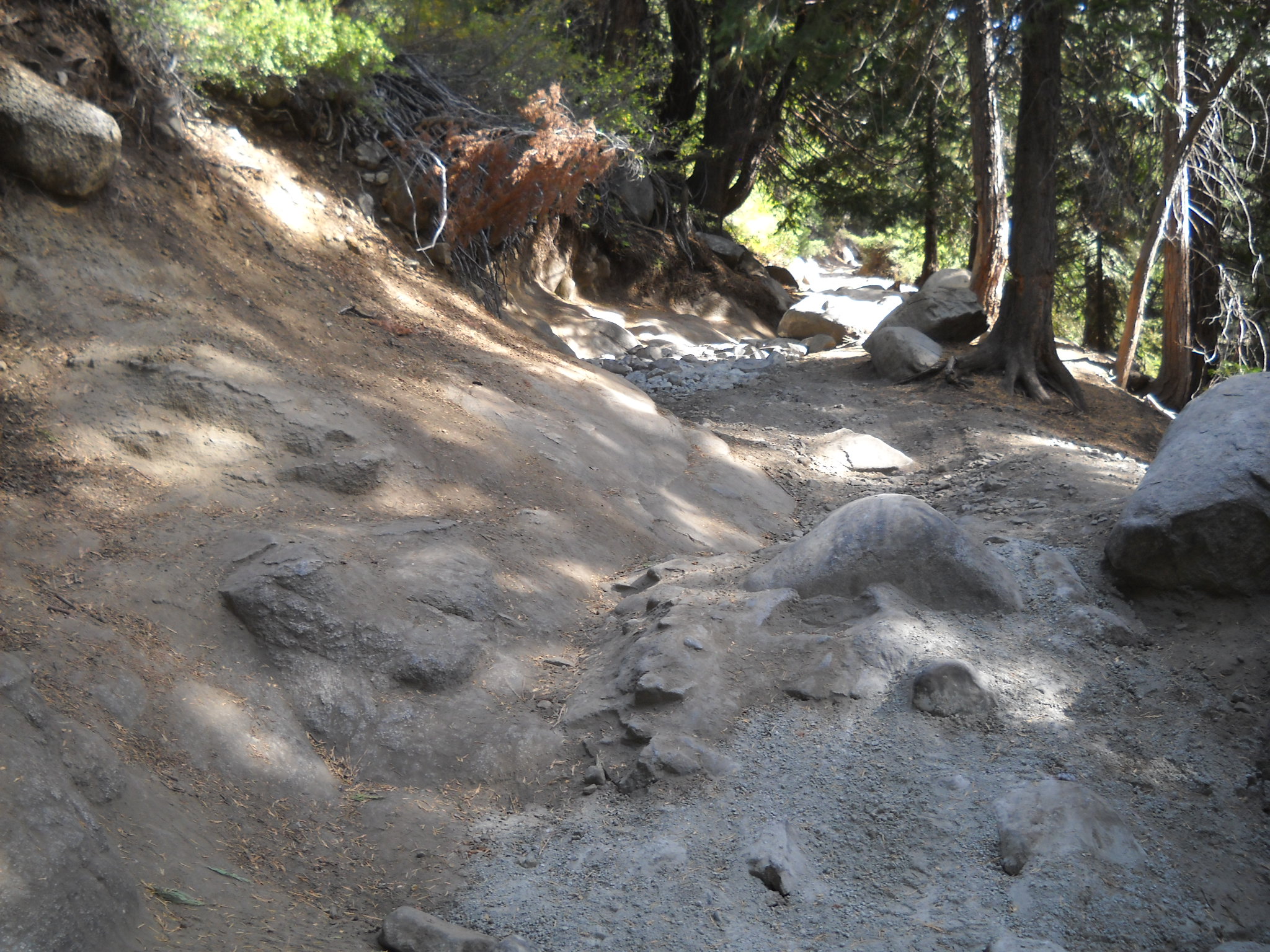
Posted: October 16, 2014 Filed under: Maintenance | Tags: maintenance, Placer, Rubicon Leave a commentLast weekend, Jeepers Jamboree folks organized, staffed and completed a maintenance effort at the Hairpin Turn on Cadillac Hill. Just after the apex of the turn, there is a climb that has a granite slab that slopes down from left to right but on the right side there is a rock that sticks up.
Over the years, the approach to this obstacle has eroded away deepening the channel down the middle of the trail and more so on the right side. The last time I was on the trail, prior to the fix, the right side was under-cut to the point my 35″ tire wouldn’t climb it. I had to back off and throw a few rocks in the hole in order to make it up that section.
Well all has changed. I don’t know how many bags of concrete were used but the channel and the hole were filled in with concrete and rock. Over this winter and after a few dozen rigs, it will get dirty and most travelers won’t even know it’s there. Points to Placer County and the OHV grant for supplying the concrete.
This is one of many spots on Cadillac Hill that is being held together with concrete. There is concrete at V-Rock, the Notch, Morris Rock and many point in between. It is needed to maintain the trail and to keep the trail safe for travelers.
Thank you Jeepers jamboree for a job well done!


 The 'Other' Rubicon