
LTBMU Starts Fire restrictions
Posted: July 2, 2014 Filed under: Travel | Tags: fire, LTBMU Leave a commentA week late, but I finally got around to posting it…
On June 26th, 2014, the LTBMU implemented fire restrictions.
Permits are required for propane stoves.
The details are linked on the “Conditions” page under fire restrictions.
Be safe.
Extreme Fire Danger – what it means to the Rubicon and OHV
Posted: May 3, 2014 Filed under: Access | Tags: ENF, LTBMU, Rubicon, TNF Leave a commentThe winter of 2013/14 was a dud. The governor of California declared a drought for California in January. Mid-summer fire conditions existed in January and continue to get worse. The fire danger on the Rubicon and other trails this coming season will be extreme and fire restrictions will come very early. Unless we get a huge late snowfall, it could be a short wheeling season.
In 2007, the Tahoe National Forest (TNF) declared extreme fire danger and with a July 2nd forest order closed the entire forest to internal combustion engines. That closure included chainsaws, motorcycles and jeeps. This closure rekindled my interest in building an electric Jeep, but that’s a topic for another article.
Due to continued hot, dry, and windy weather, fire restrictions in the Tahoe National Forest (TNF) will be increased beginning Monday, July 2, 2007…the restrictions will affect several activities:
* Fireworks – Absolutely no fireworks are permitted in the National Forest.
* Campfires – Only permitted in those campgrounds that have water systems, metal campfire rings, fire engine accessibility and regular patrols by campground hosts. Visitors can contact any TNF office for a list of campgrounds where campfires are permitted.
* Portable Stoves and Lanterns – Permitted in all campgrounds and the backcountry with a valid campfire permit.
* Woodcutting – Check the woodcutting hotlines each day to determine if chainsaws are
* Off-Highway Vehicle Use – Only permitted on designated roads; the Prosser Pit area near Truckee; and the Sugar Pine OHV area north of Foresthill. (Not permitted on trails other than the areas mentioned.)
* Smoking – Limited to vehicles, buildings, and in a 3-foot cleared area.
* Contract/Permittee Operations – Any operation or permittee that uses internal combustion engines or fire, must have an approved fire plan.
Thankfully, in 2006, the Placer County Board of Supervisors voted to recognize the Rubicon Trail as a “public trail”. That vote transferred control of the Rubicon Trail from the forest service to Placer County. Both forests involved were okay with Placer County claiming the Rubicon Trail as a public trail and thus controlling management of the trail.
WHEREAS the “McKinney Rubicon Trail” is a world renowned off-highway vehicle trail
that is partially located on federal lands within Placer County; and
WHEREAS the Trail has been in public use for at least 150 years; and
WHEREAS the Trail provides valued recreational asset for the citizens of Placer
because of the technically advanced driving conditions that exist in the open space
environment for off-road vehicle enthusiasts; and
WHEREAS the County desires that the Trail continue to be available for public use into
the future;
BE IT HEREBY RESOLVED by the Board of Supervisors of the County of Placer, State
of California, that this Board recognizes the “McKinney Rubicon Trail” as a public trail;
AND HEREBY states its intent to use all reasonable measures available to it to ensure
continued public access.
If Placer County had not voted in favor of the “public trail”, the Rubicon would have been closed in 2007 to vehicular traffic, including both Jeepers Jamborees.
A similar order in 2014, by any one of the three forests along the Rubicon, could close some of the side trails off the Rubicon. So, if you have any intention of wheeling any of these routes, do it early. Fire restrictions are progressive, they start with banning camp fires, then move to ban any open flames (including cigarettes) and progress until they ban all internal combustion engines.
Components of Stages
There are two fire restriction stages: Stage I and Stage II. There is one closure stage: Stage III. To reduce confusion and standardize the restrictions, the following conditions, by stage, should be used in all restriction documents. Additional elements may be added as conditions dictate.
Stage I
The following acts are prohibited:
- Building, maintaining, attending, or using a fire or campfire except within a developed recreation site, or improved site. 36 CFR 261.52(a).
- Smoking, except within an enclosed vehicle or building, a developed recreation site or while stopped in an area at least three feet in diameter that is barren or cleared of all flammable materials. 36 CFR 261.52(d).
- Operating or using any internal or external combustion engine without a spark-arresting device properly installed, maintained, and in effective working order meeting either the USDA Forest Service Standard 5100-1a (as amended), or appropriate Society of Automotive Engineers (SAE) recommended practice J335(b) and J350(a) (36 CFR 261.52(j)).
Stage II
The following acts are prohibited, in addition to the prohibitions of Stage I:
- Building, maintaining, attending, or using a fire or campfire. 36 CFR 261.52(a)
- Smoking, except within an enclosed vehicle or building. 36 CFR 261.52(c)
- Possessing, discharging, or using any kind of firework or other pyrotechnic device.
36 CFR 261.52(f)
- Using an explosive. 36 CFR 261.52(b)
- Operating a chainsaw or other equipment powered by an internal combustion engine between 1:00 p.m. to 1:00 a.m. 36 CFR 261.52(h).
- Operating or using any internal or external combustion engine without a spark arresting device properly installed, maintained and in effective working order meeting
either:
- USDA Forest Service Standard 5100-1a (as amended); or
- Appropriate Society of Automotive Engineers (SAE) recommended practice
J335 (b) and J350 (a). 36 CFR § 261.52(j) and 43 CFR § 9212.1(h);
- Welding, or operating an acetylene or other torch with open flame. 36 CFR 261.52(i)
- Possess or use a motor vehicle off: Forest System Roads (36 CFR 261.56) Except when parking in an area devoid of vegetation within 10 feet of the roadway; and except for parking overnight in developed campgrounds and at trailheads.
Stage III
The area is closed to all entry (36 CFR 261.52(e)) other than as follows:
- Persons with a written fire entry and activity permit that specifically authorizes the otherwise prohibited act. This may include such persons as grazing-permit holders when entry is needed to gather, move, or otherwise manage their permitted livestock, special-use authorization holders when access is needed to maintain emergency or other communications operations, and others.
- Any federal, state, or local officer, or member of an organized rescue or firefighting force in the performance of an official duty.
- Resident owners and lessees of land within the closed area.
Dates for fire restrictions being put in place on the TNF over the last decade or so range from June 1st to August 18th and in in 2011 I don’t think they EVER had fire restrictions due to the huge and late winter. Dates for lifting the ban on camp fires range from September 1st to October 23rd.
So, get out early this season. Make sure you rig is good to go now so you can take advantage of the early opening dates of the trails in the Sierras. Don’t wait for the waters and air temperatures to warm up because by the time things warm up, they might be closed.
Bring extra layers to wear instead of starting a camp fire every night even if they are still allowed. Eat sandwiches instead of steaks and cereal instead of bacon and eggs. Or have a contest with your buddies to see who can build the better solar cooker for your next camp out.
The “Who’s Who” of the Rubicon
Posted: February 17, 2014 Filed under: Access | Tags: El Dorado County, ENF, LTBMU, Placer, TNF Leave a commentWho’s Who? A look at the government agencies, clubs, organizations, forests, property owners, representatives, counties and water districts that affect or govern the world famous Rubicon Trail
Alright, this article grew to be longer than I thought as there are far more interested parties regarding the Rubicon than originally thought. That and I tend to go overboard. In no particular order:
Counties
The Rubicon Trail spans two counties, Placer County (PCo) in the east and Eldorado County (ElDoCo) in the west. The dividing line on the Rubicon Trail is the north border of the “Rubicon Springs” property. Both counties are involved with managing the Rubicon Trail. Below are links to the Rubicon Trail pages for each county.
Placer County Rubicon page:
http://www.placer.ca.gov/departments/works/mckinneyrubicon
El Dorado County Rubicon page:
http://www.edcgov.us/Government/Rubicon/Information_to_the_Rubicon_Trail.aspx?terms=rubicon%20trail
Rubicon Oversight Committee
El Dorado County has a long established committee that deals with nothing but Rubicon Trail issues called the Rubicon Oversight Committee (ROC). This has been a huge help to getting things accomplished by both the county and the users. The county run meetings are monthly meetings are attended by county officials, FOTR, RTF, users, anti-OHV people, sometimes state officials and other interested parties. The meetings are open to the public and held on the second Thursday of each month at the ElDoCo facilities in Placerville.
The county supervisors for each county are:
Jennifer Montgomery
Placer County
175 Fulweiler Avenue
Auburn, CA 95603
Norma Santiago
El Dorado County
330 Fair Lane
Placerville, CA 95667
Key county workers:
Placer County – Kansas McGahan, Senior Civil Engineer, works out of the Kings Beach office at Lake Tahoe.
El Dorado County – Vickie sanders, CAO Administrative Analyst at the County of El Dorado, I think is now in charge of ALL parks/trails within ElDoCo. A Donna Mullens is now the one sending out the minutes and agendas for the ROC meetings.
Forests
The Rubicon Trail crosses three ‘forests’: the Eldorado National Forest (ENF), the Tahoe National Forest (TNF) and the Lake Tahoe Basin Management Unit (LTBMU, technically not a forest). The Rubicon crosses the border between the ENF and the TNF at Miller Creek at the bottom of Cadillac Hill. The Trail crosses from the TNF to the LTBMU east of Miller Lake. (When you see an Arizona crossing with rocks imbedded in it, from there east is the TNF). The TNF is working to replace the sign that was once there.
Lake Tahoe Basin Management Unit (LTBMU)
Home http://www.fs.usda.gov/ltbmu
Rubicon http://www.fs.usda.gov/recarea/ltbmu/recreation/ohv/recarea/?recid=11829&actid=93
Nancy J. Gibson is the Forest Supervisor
(Still working on who should be THE contact for Rubicon issues)
Tahoe National Forest (TNF) – Truckee District
Home http://www.fs.usda.gov/tahoe
Rubicon http://www.fs.usda.gov/recarea/tahoe/recreation/ohv/recarea/?recid=56204&actid=93
Tom Quinn is the TNF Forest Supervisor
Joanne Robique is the Truckee District Ranger
Susanne Jensen is the seasonal OHV Recreation Specialist for the Truckee District
Eldorado national Forest (ENF) – Pacific Ranger District
Home http://www.fs.usda.gov/eldorado
Rubicon – The ENF does not have a Rubicon page
Lawrence Crabtree is the Forest Supervisor
Richard Thornburg is the Pacific District Ranger
Debbie Gaynor is the Recreation Specialist for the Pacific District
Water Districts
This is where things really got started back in 2000. A complaint was filed and the Lahontan Water Board stepped in to make sure the Rubicon Trail was not harming the water entering Lake Tahoe. Years later, a similar complaint was filed with the Central Valley Water Board for that watershed. Both efforts failed to close the trail but instead brought funding to maintain the Rubicon Trail.
The Lahontan Water Board manages the Lake Tahoe Basin watershed and thus covers the LTBMU. The Central Valley Water Board covers both the TNF and the ENF sections of the Rubicon Trail.
Lahontan Regional Water Quality Control Board
http://www.waterboards.ca.gov/lahontan/
Central Valley Regional Water Quality Control Board
http://www.waterboards.ca.gov/rwqcb5/
State (wide) agencies
CA State Parks – Off Highway Motor Vehicle Recreation (OHMVR)
State Parks are involved in the Rubicon Trail by providing grant funding to the national forests, and non-profit groups and by providing law enforcement as needed for the Rubicon Trail and all other OHV trails in the state.
Grant contact – George MacDougall
LEO Contact – Brian Robertson
CA Association of 4 Wheel Drive Clubs (Cal4)
Cal4 has been around for a VERY long time, if you’re not a member, sign-up now. They are THE agency that allows scores of clubs to stand together to fight for OHV access on public lands.
Nevada 4 Wheel Drive Association (N4WDA)
These guys are new to the scene. There have been Nevada state organizations around before but they didn’t last. With the new OHV registration requirements in Nevada, there was a need to have a formal group to work with those collecting the money to make sure it goes to OHV needs and not in to the general fund. There are also access fights to be fought, like the grouse issue, in Nevada.
Government (elected) Representatives
Governor
Jerry Brown
Senators
Barbra Boxer
Dianne Feinstein
State Representative for the Rubicon area
Ted Gaines – State Senator
Brian Dahle – State Assembly
Frank Bigelow – State Assembly
US Representative
Tom McClintock
Volunteer Organizations
Friends of the Rubicon (FOTR)
Rubicon Trail Foundation (RTF)
www.RubiconTrailFoundation.com
Country wide agencies
Blue Ribbon Coalition (BRC)
Tread Lightly!
United Four Wheel Drive Association
Private Property owners
Rubicon Soda Spring Incorporated (RSSI)
(Sixteen or seventeen owners in this group)
The half section that is the “Rubicon Springs”
Rubicon Trail Partnership (RTP)
(I think there are only six people in this group)
East half of the Spider Lake area
Auburn Jeep Club – private parcel
Five acres between Ellis Creek and Walker Hill
Rubicon Trail Foundation (RTF) – not yet open to vehicle traffic, working on an easement
The half section between the Spider section and the Rubicon Springs section
There are many other privately owned parcels along the Rubicon but these are the groups I had information on and that are known to support OHV use.
Disclaimer: I know this is NOT a complete list of everyone out there that is helping or at least interested in the Rubicon Trail. If you feel your organization should be on this list, send me the details and I’ll add you.
Adopt – a – trail (water bar)
Posted: January 19, 2014 Filed under: Maintenance | Tags: FOTR, grant, LTBMU, Placer, TNF Leave a commentThe Rubicon Trail Foundation has recently released information about the ability to ‘adopt’ a section of the Rubicon Trail within El Dorado County:

Okay, you’re asking, “I thought this website was about the Tahoe side of the Rubicon Trail?” Well, it is. Let me twist the story a little bit.
RTF has again stepped up to better organize getting maintenance done on the Rubicon Trail. They have worked out a plan with El Dorado County to have different clubs/groups/organizations to adopt a section of the world famous Rubicon Trail. Basic, routine maintenance and clean-up will be done by club members. Any major projects that come up will be led by the club but put out to FOTR for additional support as needed.
So, the Tahoe side twist is this, what about an “Adopt-a-water bar” program?
There were 28 ‘rolling dips’ (we all refer to them as water bars) built on the Rubicon Trail within the Lake Tahoe Basin Management Unit (LTBMU) in 2001. Over the years they have received some annual maintenance but they could use a little more love. This summer, Placer County will use OHMVR funds to create more rolling dips and drains (like 35 of them) along the Rubicon Trail between Miller Lake and the turn at Barker Pass Road (Forest Road 03).
Why not ask OHV clubs to ‘adopt’ one water feature, be it a water bar, a rolling dip or a drain? All that would be asked of these clubs would be to do maintenance on their one water feature once a year.
Dozens of clubs, from all over the western United States, organize an annual club run to the Rubicon Trail. It would be a simple addition to that trek to stop at the clubs’ one “Adopt-a-water bar” and spend an hour or so clearing the drain, digging out any sediment and re-covering any bare spots with rock.
As FOTR steps up to help Placer with labor and thus ‘matching finds’ for the OHMVR grant, the clubs involved could volunteer to adopt whatever water feature they were working on. This would establish ‘ownership’ from the beginning and instil pride in creating and maintaining each feature.
There would be some details to work out, namely, a Tahoe side local might be needed to scout the water feature to determine if any materials would be needed for any maintenance effort each year and then get those materials dropped off prior to the maintenance effort but easily overcome.
The Story of the Snow Gate
Posted: January 12, 2014 Filed under: Access, Travel | Tags: LTBMU, Placer, Rubicon Leave a comment Once upon a time, like 1999-2000, some very anti-OHV people tried to close the Rubicon Trail. They argued that Jeeps crossing seasonal creeks caused erosion and released sediment which found its way to Lake Tahoe. The only solution they saw was to close the trail.
In 2000, FOTR was formed. In 2001, 1800 cubic yards of crushed rock was placed at 28 newly built rolling dips at each seasonal creek crossing on the Rubicon Trail. This was not enough for the anti-OHV people. They argued that the rest of the trail was still wet and they wanted a gate to close the trail after the first rain of the fall that was to be opened only after the trail had completely dried out.
The private property owners said they would have to have a key to that gate and that after receiving that key they would make copies for their 10,000 closest friends. The county needed another solution.
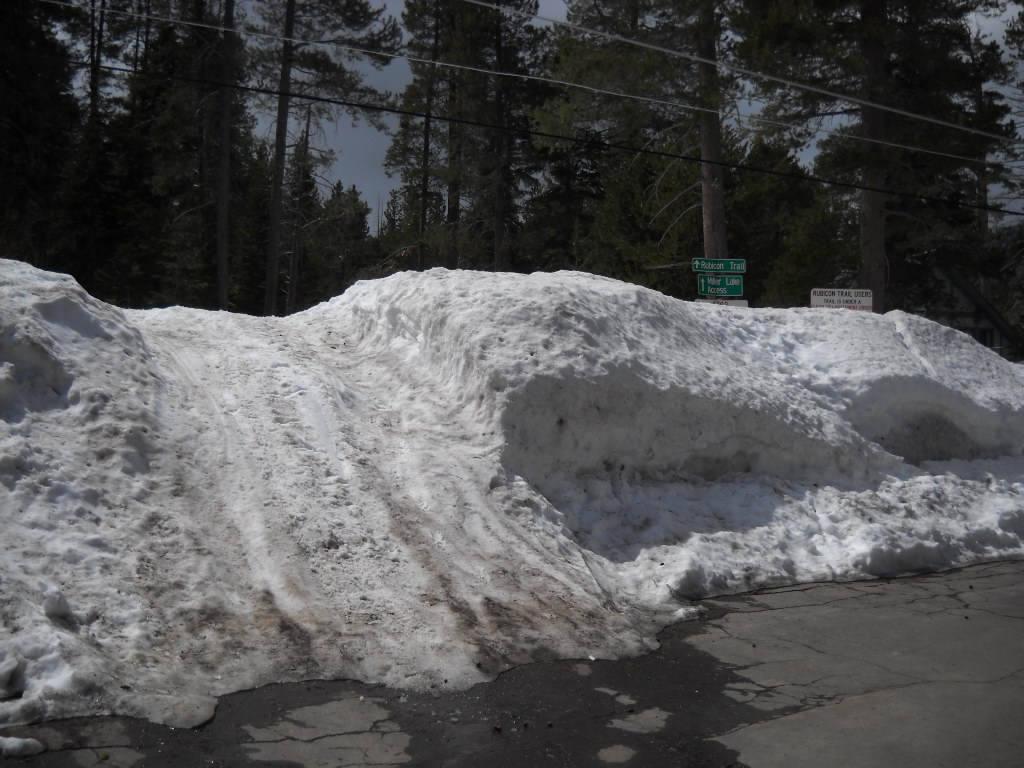
A snow-gate was proposed. The snow removed from the neighborhood streets would be piled at the entrance to the Rubicon throughout the winter, thus creating a “snow” gate and preventing winter use of the Rubicon Trail. Come springtime, once the HUGE pile of snow had melted, the assumption was that the trail would be dry enough for wheeled use.
More than a dozen years later, equipment improvements have allowed wheelers to use the Rubicon year-round. The trail never officially closes. Wheeling over the snow is probably the most ecologically friendly type of wheeling as you’re leaving tracks on several feet of snow that once it melts, you’ll never know anyone was there.
Snow is still piled at the entrance but if you have a capable enough rig, you can legally drive over the ‘snow-gate’ and access the Rubicon Trail.
John Arenz, of RTF, has compiled a list of things to carry with you while winter wheeling:
- SIGNALLING PANEL, Ultra High Visibility, two color 24” x 69” heavy duty nylon (1)
- SLEEPING BAG, mummy style w/compression stuff sack (1 for each person)
- TENT, 6 person (1)
- SLEEPING PADS, insulated (1 for each person on board
- WATER PURIFICATION TABLETS, germicidal, (25 quart )
- HAM RADIO, dual band, w/ clamshell battery and spare AAA’s
- GPS, portable
- SNOW SHOES (1 pair for each person)
- COMPLETEOUTDOOR CLOTHING (for each person)
– Full gore-tex shell
– Full inner layer
– Spare socks
– Snow boots
– Insulated gloves (2 pair)
– Snow hat
– Ski goggles
– Day pack
– Water bottle
- BUTANE LIGHTER, visible reservoir without childproof lock
- STROBE, red, emergency signaling w/industrial ‘D’ cell battery
- ALUMINUM SNOW SHOVEL (2)
- CHAIN SAW, minimum 24” bar, w/ spare fuel and chain
- FOLDING SAW, portable
- SIGNALING MIRROR, Unbreakable
- FLASHLIGHT, LED (2)
- SHELTER TARP, polyethylene reinforced/grommeted 16’ by 20’
- SUNSCREEN, SPF 30 or better
- SIGNAL FLARE GUN, w/ 12 flares
- MEAL, READY TO EAT, Assorted Menu (6 Each)
- HI CALORIE DRINKS, powder (6 quarts)
- STOVE, portable camp
- POT, portable camp
- FLARES, 15 minute for fire starting and/or signaling (6)
- COMPASS, Lensatic
- REPAIR WIRE, four-spool stainless
- LOW TEMPERATURE BLACK TAPE, ¾” x 66’ Roll (2)
- SURVIVAL WHISTLE, Dual Chamber with Hypothermia Lip Guard
- LOW TEMPERATURE RED “100 MPH” TAPE, 2” x 20 Yards
- STORMPROOF MATCHES, With Sealed Striker (Box Of 25)
- SPACE BLANKETS, silver 54” x 84” (4 each)
- PARALINE CORD, 650#, 100 feet
- POLYETHYLENE BAG , orange, multiple use, 38” x 38” 2.5 Mil (6)
- AXE, one piece
- DUFFEL BAG, High Visibility
- HAND TOOLS
- SPARE PARTS BOX
- WELDER (underhood, Premier, with cables, hood, and tools)
Those anti-OHV people still monitor what happens on the Rubicon Trail. If you go during the winter, Tread Lightly! Cross country travel is only allowed by factory tracked vehicles. Don’t spin your tires as you transition from water crossings to snow. Winch more frequently than you think you should.
Let someone know where you are going and when you plan on returning. Carry all of the stuff listed above and more, like tools and spare parts. Never wheel alone or as a single vehicle.
And my personal favorite and this website’s motto: Turnaround, don’t go around.

 The 'Other' Rubicon