
TNF Helps Clear 16E76
Posted: June 27, 2025 Filed under: Uncategorized | Tags: TNF, tree Leave a commentI reached out to the Tahoe National Forest to help clear the last tree on 16E76. They came through.

It helps that they were headed out to give a tour of the new ‘reroute’ of the Rubicon Trail.
I still have not checked 16E79. Maybe this coming Wednesday.
.
Rubicon Ronin
TNF’s VIRTUAL Open House for OHV Grant ideas
Posted: February 5, 2025 Filed under: Uncategorized | Tags: funding, maintenance, reroute, TNF, USFS Leave a commentEvery year, each national forest applies for funding through a grant program. These forests are required to seek user/public input in order to qualify for these funds.
Sadly, these forests are not required to follow the input of the users when writing the final grant application. But we do the dance in case our particular forest does listen to our input.
The Tahoe National Forest is currently in the driver’s seat regarding the Rubicon Trail and the Fordyce Trail, among many others. It is in our best interest to give our input. The details of how to do that are below. Once the draft grant application has been filled out, there is a public review period. It’s better to get your ideas in before that initial draft than try and get them in afterwards.
There is a needed Rubicon reroute that should get funded through this grant and there may be MAJOR Fordyce work funded through this grant but more likely just Fordyce planning funds.
This year it seems the USFS is still in a covid lockdown as they are only doing a “VIRTUAL” open house.
So, here’s the info…
Tahoe National Forest invites public to provide input on annual off-highway vehicle program grant application
Tahoe National Forest is preparing its annual application to the California Department of Parks and Recreation, Off-Highway Motor Vehicle Recreation Division, to request funding for trail and facilities maintenance, law enforcement and education and safety. The forest invites interested individuals and organizations to a virtual open house on Feb. 13 to learn more about the state OHV grants the Tahoe National Forest is considering applying for and how to provide input.
What: Open house to discuss Tahoe National Forest annual OHV grant proposals Where: Virtual, join on Teams
When: Feb. 13, 2025, 6 p.m. – 7:30 p.m.
Annual state OHV grants provide important funds for the U.S. Forest Service to develop and maintain trails and trailheads, repair winter storm damage and restore trailside environments, as well as provide patrolling, education and monitoring of OHV areas. When finalized, the grants will be available for public review and comment on the State of California’s website ( http://ohv.parks.ca.gov ) from March 4 – May 5, 2025.
Questions, comments or letters can be submitted through the following ways:
- In-person: During the virtual open house meeting via written comments
- Email: Trails Program Coordinator Joe Chavez, joe.chavez@usda.gov
- Mail: Tahoe National Forest, Attn: Joe Chavez, Forest Trails Program Coordinator, 631 Coyote St., Nevada City, Calif. 95959
Feedback on projects and grant opportunities is requested by Feb. 24, 2025.
Two Rubicon Reroutes In The Works
Posted: January 24, 2024 Filed under: Uncategorized | Tags: access, bypass, reroute, TNF Leave a commentLet’s cut to the chase. Here’s the Forest Service map show the two proposed reroutes:

The first and larger reroute would bypass (in orange) the shelf road above Miller Lake. This has been on the books for some-time but this latest proposal moves the intersection of the Rubicon and Forest Road 03-04 further north-west. The new proposal is longer and would bypass two low spots on the trail along Miller Meadow.
The second reroute (in yellow) would bypass the famous “mud” hole that has been repaired and is now just a water hole with a hardened base. At least I think that’s where that one runs.
Here is the “review” from September 2019:
For the record, there has been a previous reroute at the intersection of the Rubicon and Forest Road 03-04. Here’s a link to a previous post of mine, from 2014!
https://wordpress.com/post/theotherrubicon.com/877
If you were looking closely, this document came out in 2019. I became aware of it today, 1-24-24. If you read the document, “The Other Rubicon” was mentioned on page 3 as a “contacted” or “conferred with” person. Although I have worked with the Tahoe National Forest on several OHV issues, I don’t recall any formal conversations about these reroutes. I certainly do not agree with everything in this document. It would have been nice if the FS had sent me a copy of this document when published in 2019, since the3y mentioned me in it.
So, what do I not agree with? Let’s go through the document page by page.
On the very first page it talks about “activities that restore, rehabilitate”. With out going into detail, I’m not in favor of completely doing away with the sections the FS wants to bypass. The long reroute would restrict access to private property.
I laughed that on the second page the document talks about the “hundreds” of annual vehicles on the trail. It should read tens of thousands of vehicles annually!
Also on page two, “decommission three short, user created bypass trail segments”. All three users created bypasses along Cadillac Hill allow for passing, either in the same or opposite direction. I distinctly remember telling this to Joe Chavez, on the trail, while he was attempting to decommission them with a spider excavator without public input. I talked him out of it that day, I guess I’ll have to do it again.
Timeline – this document was signed in 2019. The grant process is taking place in 2024. The plan is to work the trail in 2025.
There will be a formal open house held by the FS to review all of their grant projects. Here’s the downside, the forest service is under no obligation to listen to the users input. Even if every comment is opposed a certain project, the FS can ignore that input and do the project anyway.
We’ll have to find a new way to change their minds.
.
Rubicon Ronin
Doesn’t Play Well With Others…
Posted: October 13, 2022 Filed under: Maintenance | Tags: communications, LTBMU, maintenance, TNF Leave a commentLet me start by saying that I am glad that work is finally getting done on the Rubicon Trail.
What bothers me is the complete failure to communicate.
Again, the users were not a part of the planning for this work, the users were not made aware that the work was going to take place and the users were not allowed to volunteer during this maintenance effort. Or were they?
So, the Lake Tahoe Basin Managment Unit (LTBMU) was out on the trail last week rebuilding some of the rolling dips that were put in place way back in 2000. It is my understanding that the work was funded by the Rubicon Trail Foundation (RTF), but I have not confirmed that, yet.
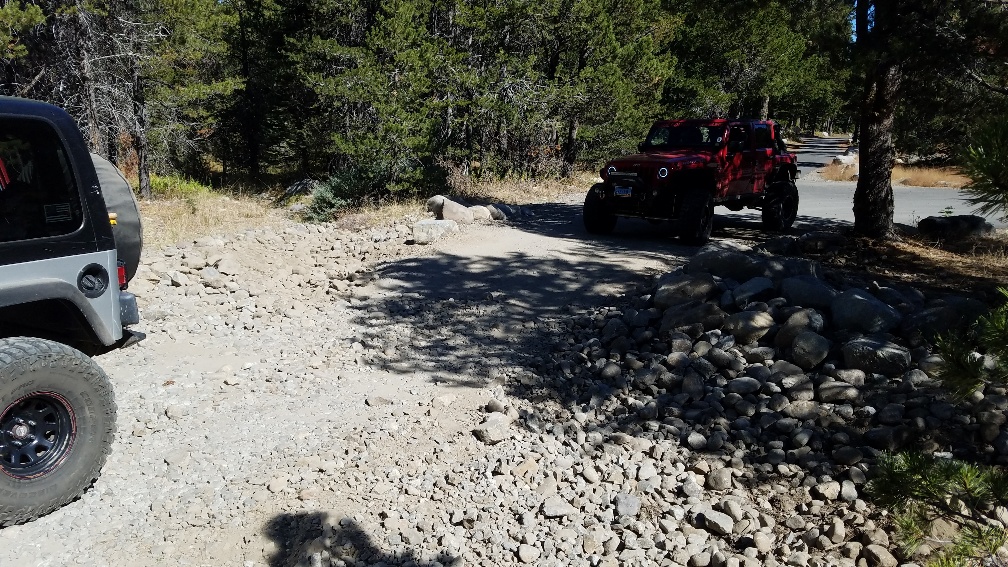
The photos are not the best, but I blame the sun, or the shadows. This is rolling dip (always improperly referred to as a ‘water bar’) is number one. Back in the day, 28 of these were placed to prevent water from running down the trail. Back then, each rolling dip was rock lined to prevent erosion.
Unfortunately, the LTBMU did not consult anyone before doing the work. Obviously, they know absolutely everything. They must tour the trail every spring documenting the run-off from melting snow. They must know the best building techniques to build long-lasting rolling dips. Or not.
Where to begin. Many of the rolling dips that were rebuilt, shouldn’t have been. Of the original 28, there were a good eight that should never have been placed. But Placer went overboard. So did the LTBMU.
If you drive the Middle Fork Trail up Blackwood Canyon, you’ll see some absolutely great rolling dips. They’re HUGE. But the LTBMU did not build the same rolling dips for the Rubicon. These are mostly loose river rock that will break down and not last.
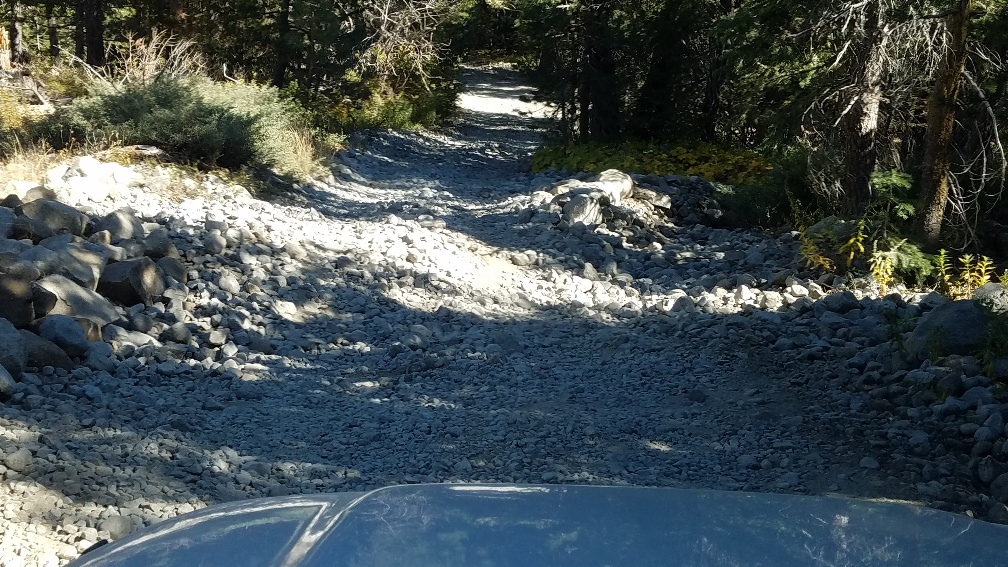
More dips…
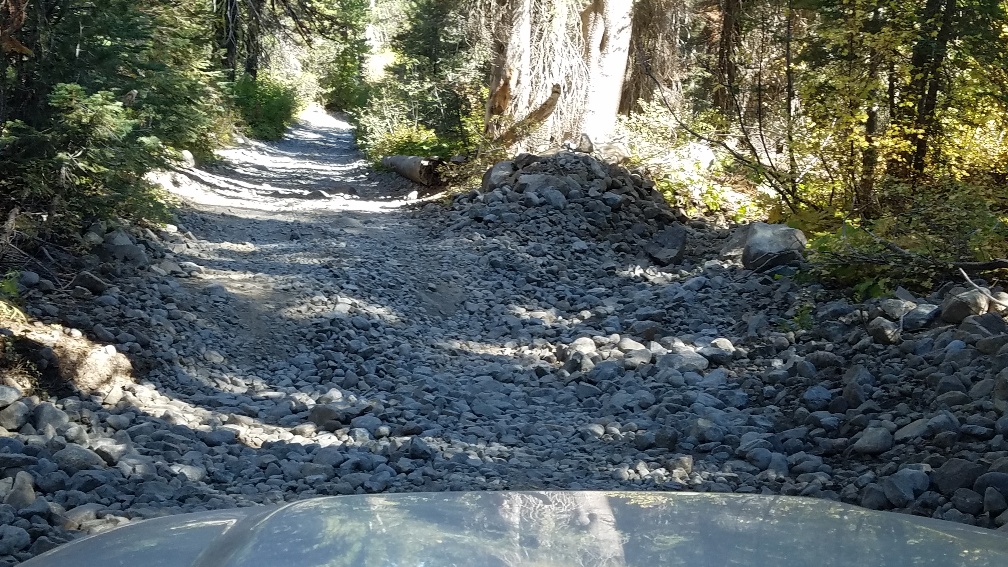
Some of the drains are dug well enough to work but others are not, or worse, don’t exist.
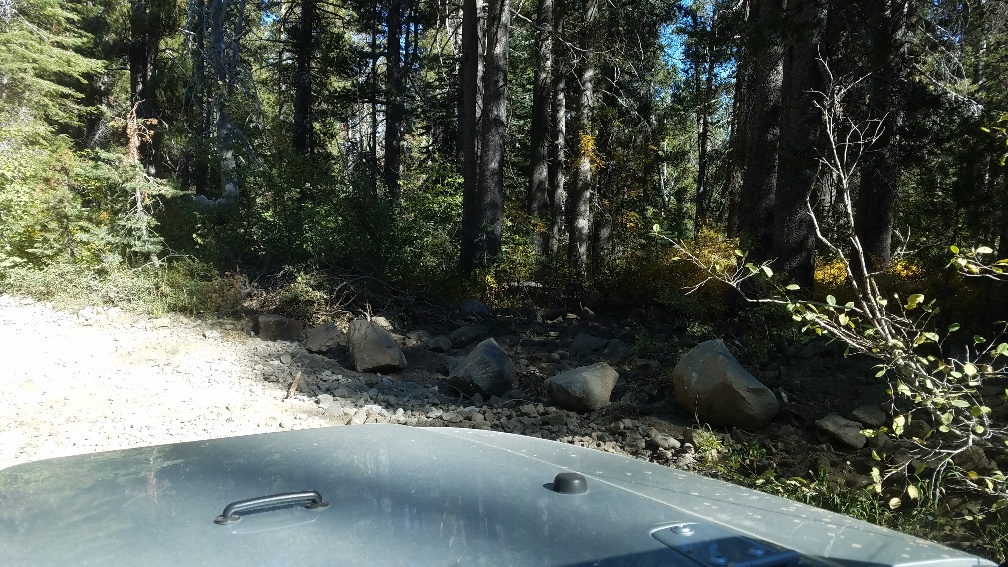
Again, some don’t exist…
This missing rolling dip is the old 7A designation. There is a creek on the right that doesn’t quite reach the Arizona Crossing (rolling dip #8). The water will continue to flow all the way down the trail to number 7, where it will be directed off the trail.

So, I alluded to the fact that the users might have known about this work. But the more I look at the email, the topic might have been other work.
Here’s the deal, on September 27th, the Tahoe National Forest (TNF) reached out about an upcoming work party for October 9th. It was a drain building/cleaning effort. I don’t know all of the names to whom the email was sent. But Friends of the Rubicon (FOTR) received it.
I honestly don’t know if the work party ever happened. But I do know that four of the largest four-wheel drive clubs on the Tahoe end of the trail never got the word. The Lake Tahoe Hi-Lo’s, Tahoe Donner 4-Wheelers, Sierra Stompers and the Hills Angels never sent out an email to their members about a work party. Reno4x4.com never posted about an upcoming work party.
So, who dropped the ball?
FOTR got the word. I’m not on that email list so I only assume it went out to the list as at least one person let me know they got it.
RTF knew about the rolling dip work, if they did indeed fund it. I never saw anything on their website about it. Just looking at their website, I don’t see anything about maintenance projects. There is an FOTR page.
So, how is the typical user supposed to learn about possible project in order to make comments before the project? How is the typical supposed to learn about scheduled projects in order to help out or avoid the trail that day?
It seems like nobody sees a need to get the word out. That’s disappointing as the users should know. The users should be involved. Volunteer time can be used as matching funds for grants.
If we could only talk to each other.
.
Rubicon Ronin
Why was the Rubicon Trail closed?
Posted: October 4, 2022 Filed under: Access, Maintenance | Tags: fire, rock, TNF Leave a commentMy last post outlined the work done by the Lake Tahoe Basin Mangement Unit (LTBMU). On Sunday, I ran the trail down to the Springs.
Along the way, it was clear that the Tahoe National Forest (TNF) had also done extensive work on the Rubicon Trail while it was closed. Large, crushed rock had been placed in many, many low spots along the trail. But not ALL the low spots and not in a few smaller very deep holes.

Note the low spot just past the rock in the picture below, not filled in:

The official word was that the trail was closed due to extreme fire danger. But in one report, individuals working with the ‘landowners’ were allowed on to the trail and down to the Springs. Now we have evidence that workers were doing extensive work over a long period of time. And the trail was closed due to extreme fire danger. I assume all of the workers were wearing Nomex, helmets and carrying fire shelters.

This is much needed work but why close the trail to do it?

If they had reached out to the users for help, we could have provided, trailers, warm bodies and financing to accomplish MORE work in the same amount of time. But they didn’t and we still have issues:

The Forest Service (FS) does not play well with others. This is evidence of that. Why? This work was done without the knowledge of the users, without any input from the users and without assistance of the users.
Now the FS, at least the Basin, in this case does not need to inform anyone when they work on their land. But the Tahoe should be informing the others, that are part of the MOU regarding management of the Rubicon, about work to be done on the trail. Did that happen?
Should the users be involved in this communications chain? Yes. Who should be informed on the part of the users? BRC, Cal4, United 4wd, RTF, CORVA, FOTR, local clubs, certain individuals?
More than ever,
.
Rubicon Ronin

 The 'Other' Rubicon